
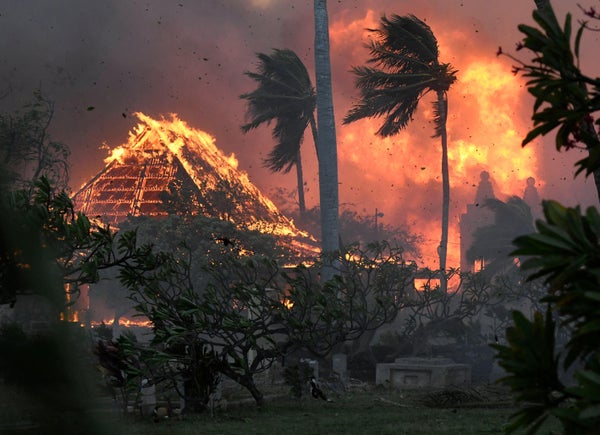


On November 23, 1903, the Iroquois Theatre opened in Chicago to rave reviews. “Few theaters in America can rival its architectural perfections,” applauded one commentator. The venue was “absolutely fireproof,” its playbills boasted.
Five weeks later, during a December 30 holiday matinee performance with 1,800 people in the audience, the Iroquois was engulfed in flames. Until the September 11 attack on the World Trade Center in 2001, it was the worst building disaster in the U.S.
Underwriters Laboratories, founded in 1894 to promote safety, joined the investigation into what went wrong at the Iroquois. The building didn’t have a single fire alarm. Crucial escape routes were barred with locked doors. And the one safety tool that could have stopped the fire at its initial spark, when an electric light ignited a curtain backstage, didn’t work: the fire extinguisher.
“A man put 10 cents’ worth of baking soda in a 5-cent tin tube. He sold it for $3 as a fire extinguisher,” fumed UL founder William Henry Merrill, Jr., likening the contraption to a phony magic wand. “Unfortunately, there was nothing ‘make-believe’ about the fire, and the result was very real to the families and the friends of over 600 women and children, whose lives were sacrificed that a man might make a profit of $2.”
Determined to prevent such pointless tragedies in the future, Merrill created a certification operation to assure the public that products with its distinctive mark had been scientifically tested and could be used safely. More than a century later, UL is still at the forefront of fire prevention.
“What made us relevant in the late 1800s is the same thing that has us relevant today, if not more,” says Steve Kerber, vice president and executive director of the Fire Safety Research Institute (FSRI), a part of UL Research Institutes (ULRI). “We’re trying to understand these new products or behaviors or technologies when they’re a concept … to understand the impact they have before people die.”
Danger at the Edge of Town
FSRI and its partners among ULRI’s other research institutes are focused on two main issues, both born of new technological and societal developments: fires caused by lithium-ion batteries and fires that ignite where wildland and urban development meet.
Wildland-urban interface fires, as they’re called, are especially hazardous. Not only do they threaten homes and businesses but “the fuel that can burn includes many things of human origin: plastics, fuels, energy-storage systems, solar panels and more,” says Christopher J. Cramer, ULRI’s interim president and chief research officer. “The gases and particulates that are produced under these circumstances are likely to be much more dangerous.”
The fire that destroyed much of the historic Maui town of Lahaina in August 2023 is one of the most devastating examples of a wildland-urban interface fire. Sparked near a school during a period of high winds and low humidity, the brush fire spread quickly. Before it was extinguished the fire killed 101 people, incinerated some 2,000 structures and inflicted $5.5 billion in damage. At the request of Hawaii’s attorney general, Kerber and an FSRI team led an independent review of the tragic fire. In addition, a team from ULRI’s Chemical Insights Research Institute (CIRI) collected dust, soil and ash samples to determine what environmental hazards lurk in the rubble.
As the foundation of its analysis, the FSRI team compiled a comprehensive timeline of the event, a huge undertaking. “You’re interviewing every single person involved, from the fire department to the police department, the emergency management agency, people from the state, people from the feds, private companies,” Kerber says.
What they’ve learned so far is “there was no single factor, or set of factors, that led to the tragic outcome,” as the team put it in their second report on the conflagration. Fed by hurricane-force winds and unmanaged, dry vegetation, the fire accelerated—and the region lacked sufficient resources to stop such an aggressive burn.
“This is not just a Hawaii problem,” Kerber emphasizes. Climate change has created warmer, drier conditions ripe for fires while urban development continues to encroach into wildland areas. As a result, he says, “this is an issue that is happening all over the country in different ways, at different risk levels.”
Faster burns and dangerous gases
One ubiquitous risk factor is that residential fires are burning faster. In house fires 40 or 50 years ago, residents would have an average of about 17 minutes to escape; now it’s just three. Open floor plans increase the amount of oxygen available to feed the flames. New furniture and housing construction use synthetic materials that take less energy to catch fire and release more energy when they burn. Kerber’s bottom line: “Our homes are not as strong as they used to be.”
The prevalence of lithium-ion batteries, FSRI’s second big issue these days, quite literally adds fuel to the fire. Not only can they ignite fires, explains Adam Barowy, a lead research engineer at FSRI, but “when they react in a thermal runaway process”—uncontrollable self-heating—“they also fuel a very fast-growing fire.”
These batteries are turning up in virtually everything. “If it used to have a cord,” Barowy says, “it probably has a battery now—and it’s probably a lithium-ion battery.” His colleagues at ULRI’s Electrochemical Safety Research Institute (ESRI) are examining whether other options, such as batteries based on sodium-ion chemistry, are less prone to thermal runaway. So far, ESRI’s studies of sodium- and lithium-ion cells appear to produce similar results.

As they explore future options, Barowy and his team are working with fire-service professionals to learn more about today’s fires. To do that, they need to ignite them. FSRI utilizes an enormous lab outside Chicago where researchers can build multiple houses and then burn them under controlled conditions. Other tests are done in the field. Kerber, who comes from a long line of firefighters and began his career as one, jokes that he’s spent the last 20 years burning buildings around the country—“a high-rise in downtown Chicago, a strip mall in Ohio.”
This time around, Barowy and his team were headed to a Delaware train yard. They partnered with Amtrak and the Fire Department of the City of New York to conduct an experiment there: What could happen if an e-mobility device (an e-bike, say) caught fire on a train car? How fast might the fire grow? How big could it get? How long could it last?
Amtrak supplied a railcar that the team equipped with a multitude of instruments including cameras, temperature sensors and pressure sensors. “We’ll measure for things like gases that could cause respiratory problems,” says Barowy. “All the things that would affect your well-being inside that closed space.”
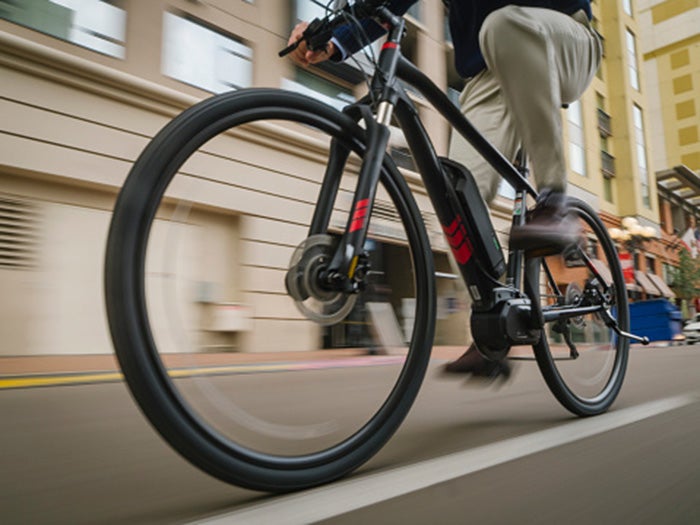
The popularity of e-bikes—whose lithium-Ion batteries can pose combustion risks—lend urgency to ULRI’s safety testing.
Sterling Lorence Photo/Moment/Getty Images
Barowy and his colleagues are worried about passenger safety, of course—e-bikes are a common sight on commuter trains and subways—but also about the well-being of the fire service professionals called to extinguish the fires. When gases are captured from an e-bike battery fire during a controlled scenario, “it helps first responders know what types of chemical exposures they could have and how to reduce them,” says Barowy.
Partnering with fire departments is a crucial part of FSRI’s mission, Kerber says. A council of prominent firefighters advises them, and firefighters are often involved in planning experiments, a culture shift for a profession that has tended to rely on tradition as a guide.
“If I’m proud of anything that we’ve done over the last couple decades,” Kerber says, “it’s been that we’ve completely changed, in my opinion, the fire-service culture to be accepting of research, accepting of science and to be willing to question what you experience on the street.”
Teaching teens about fire safety science
ULRI’s Office of Research Experiences & Education (OREE) aims to foster that type of evidence-based thinking early on. Through its open-access, online program Xplorlabs, aimed at middle and high schoolers, students are introduced to fire forensics and the science behind fire safety, drawing on ULRI’s expertise in fire forensics, fire safety, thermal runaway and more.
For an educational program on fire forensics, which is based on FSRI research, one virtual study unit “puts them in the burn scene,” says Kelly Keena, OREE’s senior director. “They can pick out the evidence that they think is going to tell them where the fire started and how it started.”
Launched in 2016, Xplorlabs is now used in some 4,000 cities around the world. Its community model pairs local fire departments with classroom teachers to educate students about the dangers as well as the science of fire. In metropolitan Atlanta, for example, four school districts have brought Xplorlabs resources into STEM classrooms and integrated their teachers with area fire service personnel in teaching partnerships.

Through ULRI’s Xplorlabs, students learn about fire causes and prevention at firefighter-supported camps.
ULRI’s Office of Research Experiences & Education
The idea is to make students aware, not afraid. “We can point to all these places that research and science actually keep us safer because we understand how fire works and how fire behaves,” says Keena.
Science has come a long way from the time when a man could claim—lethally—that a tin tube of baking soda would extinguish a fire. Yet the threat of conflagrations hasn’t gone away in the century since then. Sometimes people think of fire as “an old problem that’s been dealt with a long time ago,” says Kerber. “The truth of the matter is, it really hasn’t.”
Today, fires are adaptable, igniting from new sources and burning in new ways. But science is adaptable, too—and Kerber, Barowy and their colleagues are determined to marshal it to make the world much less combustible.
