
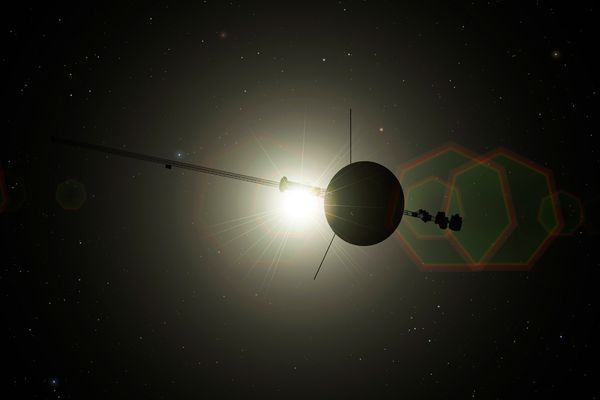
How many interstellar probes has humanity launched? If you’re not a die-hard space geek, the answer will probably surprise you: five. Yes, we currently have five spacecraft, all launched by NASA, heading out into the great beyond. Pioneers 10 and 11, along with the New Horizons probe that passed Pluto in 2015, are well on their way to crossing the fuzzy boundary between our solar system and the rest of the galaxy. They’ll eventually join Voyagers 1 and 2, which are already plying the black void between stars.
That makes me wonder: What’s the point of the Fermi Explorer mission?
Fermi Explorer is a private space venture dreamed up by entrepreneur Philip Johnston and a small team of like-minded people who want to send a small, relatively inexpensive spacecraft on a flyby trajectory past the sun’s nearest neighboring star system, Alpha Centauri. As you might expect, given the target distance of more than 40 trillion kilometers, it’ll be a while before the mission gets there: Fermi Explorer’s trip is projected to take just under 80,000 years.
On supporting science journalism
If you're enjoying this article, consider supporting our award-winning journalism by subscribing. By purchasing a subscription you are helping to ensure the future of impactful stories about the discoveries and ideas shaping our world today.
Mark your calendars.
The mission’s specific objectives for its (as-yet-unbuilt) 100-kilogram spacecraft are to carry a payload mass of at least one kilogram, to pass by Alpha Centauri within 500,000 years at a distance of less than about 400 billion km and to launch sometime in 2029—all for a price tag below $15 million.
Mind you, none of this is infeasible. I dare say it’s not even improbable. Launch costs for such a trip used to be prohibitive, but rideshare programs—in which several small satellites are launched at the same time in a single rocket, like people sharing a cab—lower the cost significantly. Launch for such a mission could easily be less than $1 million, and by using off-the-shelf technology, the spacecraft could be designed and built relatively cheaply.
The most expensive part of Fermi Explorer would probably be operation cost, such as salaries for personnel, and that’s because of the mission’s duration, which in turn depends on the propulsion and trajectory needed to leave the solar system. While chemical rockets could be used to give the spacecraft the kick it would need to escape the sun’s gravity, that approach would violate the mission’s mass—and budget—constraints.
Instead Fermi Explorer will use solar-electric propulsion: solar panels will power a small thruster that ionizes atoms of xenon and employs a powerful electric field to shoot them at very high speed out the back of the spacecraft. The thrust from such engines is low—just a whisper of force, about the same as the weight of a sheet of paper resting in your hand. But this thrust can be maintained for days, weeks or even months, allowing the spacecraft to build up a terrific velocity. All that additional time adds to the operation cost, however.
Moreover, the trajectory out of the solar system takes years. The plan is not to simply fling Fermi Explorer out toward Alpha Centauri. Instead the idea is that the spacecraft will use a well-understood process utilizing the Oberth effect. The maneuver will start with the spacecraft thrusting backward, opposite the direction of Earth’s motion around the sun, so that Fermi Explorer will drop closer to the sun in a series of ever more elongated, elliptical paths. The spacecraft will move fastest when at its perihelion, or closest point to the sun; thrusting forward will then maximize the increase in its speed. This is very similar to pumping your legs on a playground swing to increase the height of your arc.
After a half-dozen such maneuvers, a final long burn at perihelion would give the spacecraft enough oomph to achieve escape velocity, eventually allowing it to leave the solar system at a speed of about 24 kilometers per second relative to the sun. That final perihelion thrust would occur in the year 2043, and Fermi Explorer would take roughly 15 to 20 more years to pass what is generally accepted as the boundary between the solar system and interstellar space. From there, it would be a quick 80 millennium jaunt to Alpha Centauri.
Again, to be clear, all of this is technologically doable right now.
That brings me back to my original question: Why do this?
According to Johnston and his collaborators, the point is in the name. The Fermi paradox is an apparent—but so far still unexplained—contradiction between how seemingly easy it is for intelligent life to explore the entire galaxy in cosmically short times and how there’s no compelling evidence that aliens have visited Earth. (The paradox is attributed to physicist Enrico Fermi, who allegedly stated this conundrum succinctly at a lunch with colleagues discussing aliens: “But where is everybody?”)
The team behind Fermi Explorer wants to show that the holdup is not linked to any lack of ability to send probes to other stars—one of the potential roadblocks to galactic exploration. Thus, the team’s proposal for a demonstrative mission to Alpha Centauri.
I’m scratching my head about this, however, because we’ve already blown through that roadblock by sending five probes on interstellar trajectories.
Now, to be fair, those NASA spacecraft are just heading out into space somewhat willy-nilly after flying by their planetary targets in our own solar system; none is bound for Alpha Centauri or any other nearby star. But sending something to a specific interstellar destination isn’t that much harder. Missions from NASA, the European Space Agency and others have threaded interplanetary trajectory needles with incredible precision. Targeting a star, even one that’s thousands of times farther away than anything we’ve previously visited, isn’t that big a leap.
The team also makes a point of inspiring people to think about space exploration and the Fermi paradox, as well as the possibility of “great filters,” which are potentially extinction-level barriers to a species achieving space travel. But I’m not convinced of the efficacy of its plan here. Again, we already have probes on their way to the stars, and we also know public interest in a specific mission can wane. I’d wager Fermi Explorer is especially prone to this because of its mass and cost constraints, which prohibit it from carrying equipment for maintaining long-term contact with Earth; it wouldn’t get very far before slipping permanently out of communication range. And just to state the obvious, it would beam back no science from or about Alpha Centauri itself. Out of sight, out of mind.
If inspiration is the goal, I’d argue that setting up a scholarship for young students (especially in underserved communities) to study interstellar space exploration could be more effective—and easier, too.
The timing on this announcement is a bit ironic as well: right now the New Horizons team is struggling with a NASA decision that may force it to switch off two important instruments that measure the space environment around the probe. Unlike the Voyager spacecraft, which are running out of power and need to conserve it, New Horizons’ woes are linked to budgetary shenanigans brought on, at least in part, by the Trump administration’s peculiar antipathy to many areas of scientific research. The White House has repeatedly proposed devastating cuts to NASA’s science budget, leaving the agency scrambling to essentially look for loose change between the sofa cushions. The New Horizons instruments only need about $2 million a year to operate—less than a ten thousandth of NASA’s annual budget.
And New Horizons actually returns valuable science from deep space. Fermi Explorer won’t be able to carry much in the way of scientific instrumentation and wouldn’t be able to do much actual exploration with them even if it did—again thanks to the limited range of its communications.
I am not exactly against this mission—people and private ventures are free to spend their money as they wish—but I do have serious doubts about what exactly is new here, why it’s being done and what will really be accomplished.
Is interstellar space worth exploring? Absolutely. But not all missions to get there are equal.