
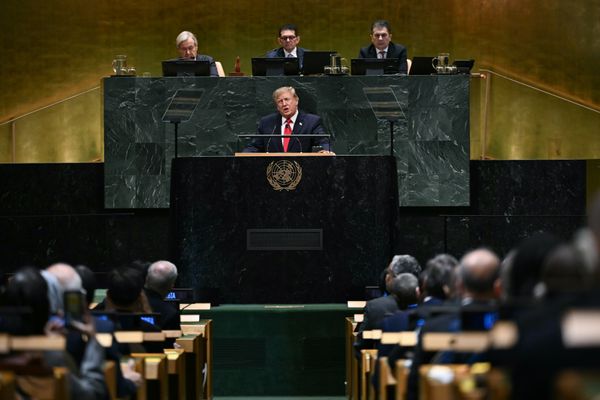
President Donald Trump rejected international efforts to regulate artificial intelligence during a speech to the United Nations General Assembly on Tuesday. Trump compared the apparent risks of AI to climate change and falsely claimed that the latter has been a hoax that hasn’t lived up to warnings of its dangers.
“The United States ... totally rejects any attempt to construct a globalist scheme to control for the artificial intelligence being spoken of so much now,” he said.
The speech came days after Trump launched a poll in which he asked his social media followers to vote for “Superior Intelligence,” “Extreme Intelligence” or “Supreme Intelligence” as a new moniker for AI. “Many people think that the words ‘Artificial Intelligence’ are inaccurate, and very ineloquent,” he wrote.
On supporting science journalism
If you're enjoying this article, consider supporting our award-winning journalism by subscribing. By purchasing a subscription you are helping to ensure the future of impactful stories about the discoveries and ideas shaping our world today.
In the address, Trump instead referred to AI as “super intelligence,” arguing that the term artificial “makes it sound fake, and it is not fake. It’s actually amazing. But we have to be careful.”
He decried AI critics as “the very same people who said we’ll all be dead in 12 years because of global warming—a name since reborn to climate change because the planet was cooling, not warming—and nobody was dead.”
The president has repeatedly referred to climate change as a hoax and has twice pulled the U.S. out of the Paris Agreement to limit warming to 1.5 degrees Celsius above preindustrial averages. And so far, during his second term, Trump’s administration has rolled back emissions regulations, eliminated major climate programs and slashed funding for climate change research.
His comments on AI stand in stark contrast to recent calls for greater regulation and “pacing” of the technology from the leaders of several prominent AI companies, including OpenAI’s Sam Altman and Anthropic’s Dario Amodei. In his address on Tuesday, Trump rejected the notion, saying whoever masters the technology first wins.
“I’m not going to stifle growth of something that will be bigger than the industrial revolution,” he said.