New Issue: Orbital Catastrophe Ahead? Read Now

Tropical Storm Dolly forms in the Atlantic

It’s a weird meteorological coincidence on the heels of Dolly Parton’s death

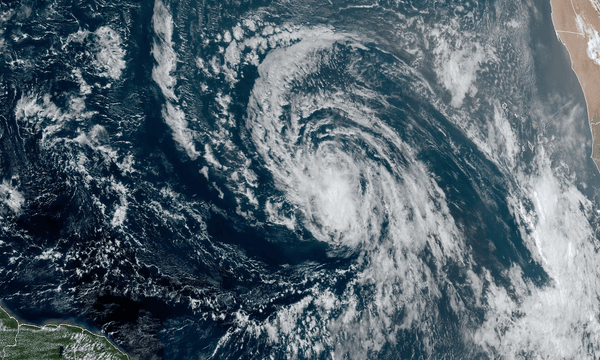
A satellite image of tropical storm Dolly.

Tropical Storm Dolly, as of August 27.

GOES/NOAA

Join Our Community of Science Lovers!

On Tuesday the legendary and beloved music icon Dolly Parton passed away. On Thursday a tropical disturbance managed to overcome headwinds to become a tropical storm. And the next name on the list of Atlantic storms was, you guessed it, Dolly.

Here’s how this unlikely meteorological coincidence happened.

The Atlantic hurricane season officially runs from June 1 to November 30, but late August through September is a peak time for storm formation. That’s when ocean waters are warmest, providing ample fuel for storm convection. It’s also when the winds that can rip apart a storm are typically at their weakest.


On supporting science journalism

If you're enjoying this article, consider supporting our award-winning journalism by subscribing. By purchasing a subscription you are helping to ensure the future of impactful stories about the discoveries and ideas shaping our world today.


A remarkably strong El Nino has kept a lid on Atlantic activity so far this season, meaning we’re still toward the beginning of an alphabetical list of storm names for 2026 that was created by the World Meteorological Organization. There are actually six lists that we rotate through each year, and we replace names on the lists when particularly damaging or strong storms cause them to be retired.

In its forecast discussion, the National Hurricane Center (NHC) said, “The timing of the use of the name Dolly for this storm is purely coincidental,” an unusual statement about a storm name.

The name “Dolly” has actually been on one of the lists of hurricane names since 1953, the first year that storms were given names based on lists from the NHC—when Dolly Parton was only seven years old. Back then only female names were used. The lists began alternating between male and female names for Atlantic storms in 1979. Dolly had dropped off the lists before that but was added back in 1990 and first used for a storm in 1996. (Fun fact: In the western Pacific, typhoons—which are the same phenomena as hurricanes but go by a different term—are named for national symbols, local animals and other features of affected countries.)

Though Dolly Parton had an enormous effect on people around the world, with efforts that included promoting childhood literacy and funding one of the COVID vaccines, Dolly the storm is expected to have little impact. Wind shear will make it hard for the storm to strengthen and will eventually deconstruct it before it reaches the Leeward Islands.

Andrea Thompson is senior editor for Earth and environment at Scientific American, covering the environment, energy and Earth sciences. She has been covering these topics for nearly two decades. Prior to joining Scientific American, she was a senior writer covering climate science at Climate Central and a reporter and editor at Live Science, where she primarily covered earth science and the environment. She has moderated panels, including as part of the United Nations Sustainable Development Media Zone, and appeared in radio and television interviews on major networks. She holds a graduate degree in science, health and environmental reporting from New York University, as well as a B.S. and an M.S. in atmospheric chemistry from the Georgia Institute of Technology. Follow Thompson on Bluesky @andreatweather.bsky.social

More by Andrea Thompson

Subscribe to Support Independent Journalism

Great science journalism requires human expertise, time, effort and creativity. And it costs money. That’s why I and the journalists here at Scientific American hope you’ll join our community.

When you subscribe, you are supporting staff and freelance journalists who are passionate about telling science stories that are true, important and compelling. Our editors and reporters are often experts in their fields, which means they understand the nuances of big discoveries and can untangle the breakthroughs from the hype. With a subscription, you are also supporting rigorous fact-checking to ensure the words we publish are precise and accurate. And you’re supporting original illustrations, graphics and photos that bring you closer to an advanced laboratory, an ice sheet in Antarctica or a space mission in orbit. You’re helping us craft other types of high-quality journalism as well: Our newsletters are carefully written, edited and curated by staffers you have or will come to know and love. Our Science Quickly podcast is based on original reporting, collaboration with editors and scientists and exacting production.

Subscriptions keep this engine running so we can continue to deliver thoughtful, rigorous and independent science journalism to you. In an era of viral misinformation, this work is crucial. If you value what we do, I hope you’ll consider joining us as a subscriber

Thank you,

Jeanna Bryner, Editor in Chief, Scientific American

Subscribe