
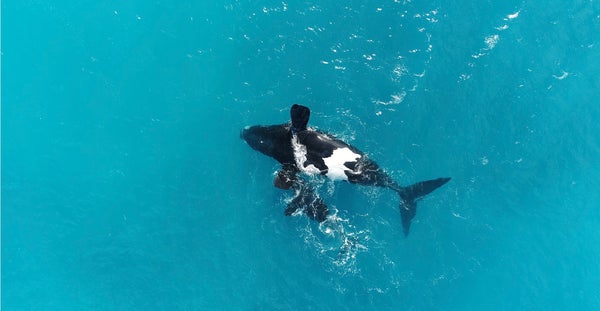
Being a mom can be an exhausting job. Taking a break every now and then is much needed for mothers of many species—whales included. And that could be the motivation behind a peculiar habit of some southern right whales (Eubalaena australis), the only whale species known to flip upside down.
“This is definitely an unusual behavior,” says Renae van Noort, a conservation biologist at the University of Western Australia. “It looks quite odd, especially when you see them from a distance with their pectoral fins out of the water.”
Southern right whale mothers live extreme lives. They spend months eating and storing energy in Antarctica and then embark on long migrations to reach their calving grounds, where they give birth and care for their young—all without eating for months. At this crucial time, resting and saving energy becomes a matter of life or death because they need enough to both feed their young and make the journey back to their feeding grounds, where they will finally be able to eat again.
On supporting science journalism
If you're enjoying this article, consider supporting our award-winning journalism by subscribing. By purchasing a subscription you are helping to ensure the future of impactful stories about the discoveries and ideas shaping our world today.
Van Noort and her team decided to take a closer look at how these whale mothers conserve energy by filming them and their calves using drones in the bay of Head of the Bight in South Australia, where southern right whales aggregate and give birth. Some 75 hours of footage of 90 mother-calf pairs showed that the mothers spent an average of 33 percent of their time resting, the team reported on July 6 in Mammalian Biology. Calves also rested, mostly when their mothers were resting, too.
The cetaceans most commonly rested by floating dorsal-side-up at the surface, as well as below it. But some mothers—25 percent of the total—also had another strategy: upside-down resting. “We are still unsure why some mothers rest this way and others don’t,” van Noort says.
The behavior only occurs in southern right whales. This may be because mothers of other species have different ways of conserving energy, says Malin Lilley, a comparative psychologist at Texas A&M University–Central Texas, who wasn’t involved in the new study. “Or they might not rest in habitats that are as relatively undisturbed by human activity as this particular population of southern right whales,” she adds. Rolling on their backs makes whales more vulnerable to being hit by ships.
Mothers rolled onto their backs only rarely—just 2 percent of their time—both under and above the water surface. The team documented the behavior only in lactating mothers and one pregnant whale, which suggests that getting in this position might be nothing more than a way for whale moms to get a break. When they are lying upside down, their calves cannot reach the mammary slits to get milk—meaning the mothers can decide when it’s feeding time.

A southern right whale mother and her calf swimming.
Fredrik Christiansen
Lying upside down might also help with regulating their temperature, cooling it off thanks to the fresh air hitting their fins.
Lilley says that future research could investigate how and when whale mothers learn to rest in this position. “They might learn from their own mothers, from previous experiences with calves or maybe from observing fellow mothers,” she says.