
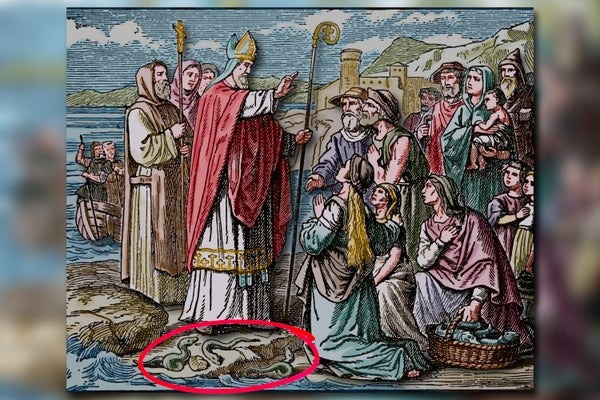
When merrymakers gather in the streets of Dublin for Ireland’s annual National St. Patrick’s Day Parade, one green-clad group won’t be there: snakes.
Saint Patrick, a fifth-century missionary from Roman Britain, is primarily known for spreading Christianity within Ireland. His other claim to folklore fame, however, comes from his supposed role as an exterminator—he’s said to have chased all the snakes out of Ireland with an ornate shepherd’s crook known as a crozier.
A haven for those with ophidiophobia, Ireland has zero native snake species. This snake-free status predates Saint Patrick, though. In fact, the fossil record suggests the island has never hosted wild serpents—or many other reptiles, for that matter.
On supporting science journalism
If you're enjoying this article, consider supporting our award-winning journalism by subscribing. By purchasing a subscription you are helping to ensure the future of impactful stories about the discoveries and ideas shaping our world today.
“We really only have two reptiles,” says Collie Ennis, science officer at the Herpetological Society of Ireland and biodiversity officer at Trinity College Dublin. “We’ve got one native land reptile—that’s the common lizard.... We also have an introduced reptile in Ireland called the slow worm, and it’s a type of legless lizard.”
Most scientists agree that the most recent ice age, which ended approximately 11,700 years ago, is the reason for Ireland’s lack of reptile diversity. By the time glacial ice from the era receded and temperatures warmed enough for the ectotherms, Ireland had broken off from the European continent and was inaccessible to roaming reptiles.
Even today, Ireland is simply too cold for most snakes. Because reptiles cannot warm themselves internally like mammals can, they tend to prefer warm temperatures between 70 and 100 degrees Fahrenheit (21 and 38 degrees Celsius) and can be rendered immobile or perish from lengthy cold spells. Ireland’s native common lizard (Zootoca vivipara) and the introduced slow worm (Anguis fragilis) are both much hardier and able to hibernate through the winter.
Geographic isolation and cold temperatures have actually hindered snakes from populating the wilds of many islands; New Zealand, Iceland and Greenland are all also snake-free.
Still, being naturally snake-free doesn’t mean there isn’t a single snake slithering around Ireland. The Dublin Zoo and the National Reptile Zoo in Kilkenny are both home to several snake species and see many thousands of visitors each year. And among Ireland’s pet owners, snakes are becoming a progressively more popular choice.
“In my lifetime, we went from where the only time you’d see a snake in Ireland would be in the actual zoo ... to many people of all ages keeping them as pets,” Ennis says. “I think they’re one of the favorite pets we have in the country at this point in time, so there is a huge interest in reptiles.”