
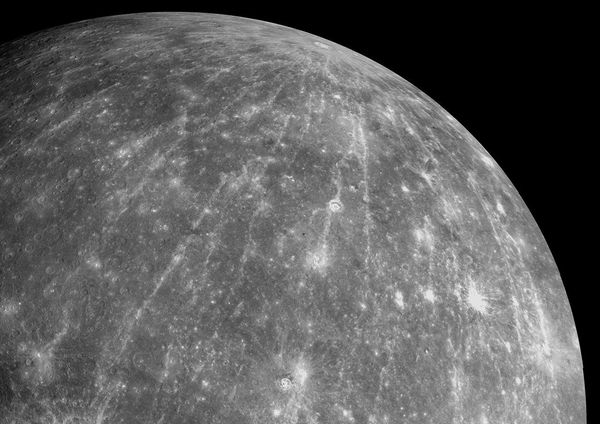
Everyone gets wrinkles eventually—even planets. On Mercury, these signs of aging look like hills and ridges, called shortening structures, across its surface. As the planet shrinks and contracts over time, more of these ridges rise up. And according to a new analysis, there are far more of them than scientists had realized.
Scientists have long known that Mercury’s interior was shrinking: for the past 4.5 billion years, the planet has contracted as it cooled from its fiery origins. But the new research, published in Geophysical Research Letters on Thursday, shows that it’s actually shrunk a lot more than previously estimated, providing new insight into the planet’s evolution and makeup.
Mercury is particularly mysterious because it is so close to the sun: It is difficult to send spacecraft there (just one has ever entered orbit, although another mission is about to attempt that feat). And the light from our home star is so bright that it is hard to observe Mercury from Earth. We’ve certainly never been able to land a craft that could peek beneath its surface. That means planetary scientists must rely on data from remote satellites to paint a picture of the planet’s history and inner layers.
On supporting science journalism
If you're enjoying this article, consider supporting our award-winning journalism by subscribing. By purchasing a subscription you are helping to ensure the future of impactful stories about the discoveries and ideas shaping our world today.
The new analysis focused on the planet’s surface roughness, such as craters or debris, and found that particularly rough areas have made the wrinkles harder to see. Accounting for that obstruction, the researchers estimate that Mercury has likely shrank 10 to 30 percent more than previously thought.
“In this work, the authors have thought about an additional angle to figuring out Mercury’s geological history from afar, which is the effect of surface roughness from billions of years of impact bombardment,” says Paul Byrne, a planetary scientist at Washington University in St. Louis, who was not involved in the study. “If their results hold, and I’m confident they will, then we’ll have taken a step further in investigating planets we can’t yet visit in person.”
Byrne presented findings at a 2013 conference that indicated that Mercury had shrunk by about 11 kilometers; the new study suggests it instead may have done so by up to 23 kilometers, or about 14 miles. Even that might be an underestimate, the new study’s authors write, because existing surface data may be incomplete.
Retracing the history of Mercury enables scientists to better understand what’s going on underneath its rocky surface, says Gaku Nishiyama, lead author of the study and a planetary scientist at the German Aerospace Center.
“The new estimates on Mercury’s radial contraction would tell a different scenario of Mercury’s thermal evolution,” Nishiyama says. “So what would be the implication on Mercury’s evolution when this new estimate is used? This is the next question that we have to tackle.”
The implications could stretch galaxy-wide, Byrne adds. He is “positive” that other celestial bodies such as the moon and Mars may show similar shrinkage.
“Do those worlds next!” he says.