New Issue: Orbital Catastrophe Ahead? Read Now

The Perseid meteor shower peaks today alongside the total solar eclipse—here’s how to see it

Skygazers are in for a treat on August 12, as one of the most spectacular meteor showers coincides with a total solar eclipse

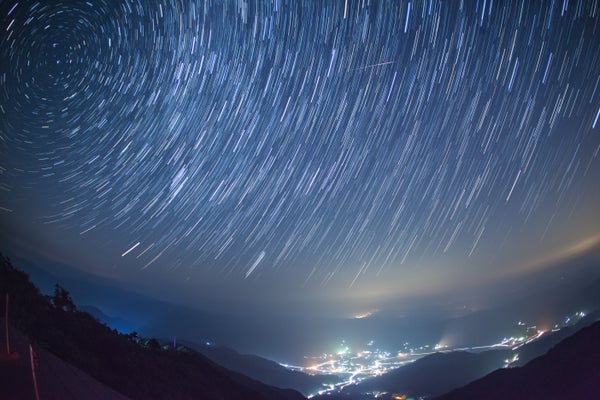
time lapse image of night sky

Perseids meteor shower over Okayama, Japan, with a shooting star through the middle of the frame

tdubphoto/Getty Images

This article is part of a special report on the total solar eclipse that offered the best views from the Arctic Circle, Iceland, Spain and parts of Portugal on August 12, 2026.

Join Our Community of Science Lovers!

Updated August 12, 2026 at 9:00 AM

The Perseids have a reputation. The “best meteor shower of the year,” according to NASA, this annual light show is prolific, with bright meteors falling all over the sky and occasionally a fireball or two—or sometimes dozens.

And this year, the peak of the Perseids may be even more impressive: it just so happens that some of the meteor shower’s busiest hours fall on August 12—the same date as a total solar eclipse.

Meteor showers occur when the Earth’s orbit crosses paths with a trail of dust and debris left behind by an asteroid or comet. In the case of the Perseids, the cosmic debris comes from an unusually large comet called 109P/Swift-Tuttle, which is about 16 miles (26 kilometers) across. That’s why this meteor shower happens annually—it passes through the debris stream every trip Earth makes around the sun.


On supporting science journalism

If you're enjoying this article, consider supporting our award-winning journalism by subscribing. By purchasing a subscription you are helping to ensure the future of impactful stories about the discoveries and ideas shaping our world today.


The Perseids occur from mid-July through to late August. This year's peak—the period with the most meteors—is on August 12 and August 13. On those days, skygazers can expect to see between 30 and 50 meteors an hour or more. Wednesday, August 12 is also the date of a total solar eclipse—an event that happens when the moon passes directly in front of the sun, leaving a swath of Earth in darkness for a few brief minutes.

For those in the path of totality, the region where the moon will completely block out the sun’s light, you may catch a glimpse of the Perseids for the approximately two minutes you’ll be in the moon’s shadow. That includes parts of Greenland, Iceland, Portugal, Russia and Spain. You can read our eclipse watching guide to see the path of totality and how to best view this celestial phenomenon.

If you miss the peak, you can still catch Perseids until around August 24, according to the American Meteor Society. If you’re not in the solar eclipse path, the greatest visibility tends to be in the pre-dawn hours. For the best viewing, try to get to a safe, dark outdoor place away from city lights on a day without cloud cover or a bright moon. Give your eyes about 30 minutes to acclimatize to the dark, and look up!

Jackie Flynn Mogensen is a breaking news reporter at Scientific American. Before joining SciAm, she was a science reporter at Mother Jones, where she received a National Academies Eric and Wendy Schmidt Award for Excellence in Science Communications in 2024. Mogensen holds a master’s degree in environmental communication and a bachelor’s degree in earth sciences from Stanford University. She is based in New York City.

More by Jackie Flynn Mogensen

Subscribe to Support Independent Journalism

Great science journalism requires human expertise, time, effort and creativity. And it costs money. That’s why I and the journalists here at Scientific American hope you’ll join our community.

When you subscribe, you are supporting staff and freelance journalists who are passionate about telling science stories that are true, important and compelling. Our editors and reporters are often experts in their fields, which means they understand the nuances of big discoveries and can untangle the breakthroughs from the hype. With a subscription, you are also supporting rigorous fact-checking to ensure the words we publish are precise and accurate. And you’re supporting original illustrations, graphics and photos that bring you closer to an advanced laboratory, an ice sheet in Antarctica or a space mission in orbit. You’re helping us craft other types of high-quality journalism as well: Our newsletters are carefully written, edited and curated by staffers you have or will come to know and love. Our Science Quickly podcast is based on original reporting, collaboration with editors and scientists and exacting production.

Subscriptions keep this engine running so we can continue to deliver thoughtful, rigorous and independent science journalism to you. In an era of viral misinformation, this work is crucial. If you value what we do, I hope you’ll consider joining us as a subscriber

Thank you,

Jeanna Bryner, Editor in Chief, Scientific American

Subscribe