
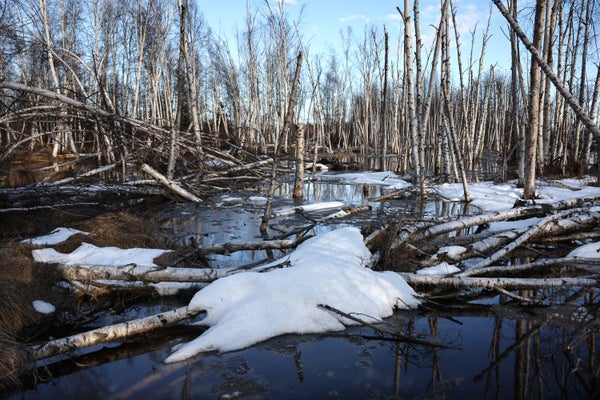
Thawing permafrost is among climate science’s worst “positive feedback loops”: As the world warms, permafrost—essentially frozen soil—thaws, releasing fresh water and carbon into the environment. That release further fuels climate change, driving more warming. (Thawing permafrost has also raised concerns about unleashing new pathogens on humanity.)
And in Alaska, the loop seems to be speeding up. In a new study, researchers tracked how thawing permafrost in a Wisconsin-sized section of the North Slope region of Alaska has added fresh water and dissolved organic carbon to estuaries off the Alaskan coast between 1980 and 2023.
In more recent years, the region released nearly 12 cubic kilometers (three trillion gallons) per year, more water than it did from 1980 to 1984. That’s enough to fill more than 4.5 million Olympic swimming pools, estimates Michael Rawlins, lead author of the study and an extension associate professor of Earth, geographic and climate sciences at the University of Massachusetts Amherst.
On supporting science journalism
If you're enjoying this article, consider supporting our award-winning journalism by subscribing. By purchasing a subscription you are helping to ensure the future of impactful stories about the discoveries and ideas shaping our world today.
Fresh water is a problem for the ocean—it disrupts sea ice formation, alters the salinity of coastal lagoons and bays, could threaten global ocean circulation and carries carbon that’s later released into the atmosphere.
From the early 1980s to 2023, the amount of carbon that northern Alaska’s rivers release into the ocean every year has risen from about 120 gigagrams to about 170 gigagrams—an increase of about 50,000 metric tons of carbon per year.
“Some of that carbon has been locked up for tens of thousands of years. It’s now thawed, mobilized in the rivers, gets to the ocean, where some of it becomes part of the atmosphere,” Rawlins says, comparing this to fossil fuel extraction. “Outgassing”—the release of methane or carbon dioxide—can happen from rivers directly before it reaches the ocean, too.
The study could help researchers better understand permafrost-fueled carbon emissions across the Arctic, a region that is warming about three times faster than the rest of the planet, scientists estimate.
“As we try to better understand the amount of carbon in the ocean, we need good estimates of the amount coming out of these rivers,” Rawlins says.
The findings were published on Wednesday in the journal Global Biogeochemical Cycles.