
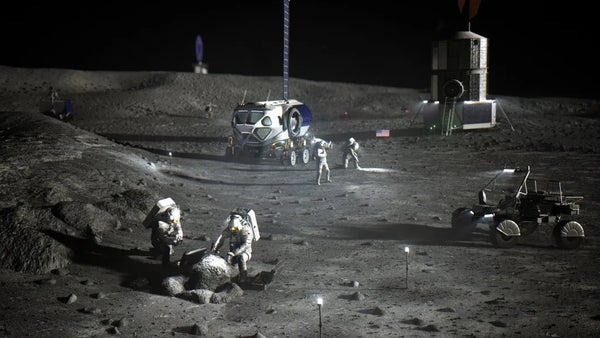
NASA plans to land humans on the moon for the first time in more than half a century by 2028—but such expeditions could unwittingly bring hitchhiking microbes to the lunar surface capable of surviving there.
In a new study published Wednesday in Science Advances, NASA researchers found that five kinds of microorganisms that could feasibly find their way aboard one of the agency’s upcoming Artemis moon missions may be able to live at the lunar south pole. On Earth, these little life-forms are resistant to harsh conditions such as extreme cold, meaning they could theoretically survive if they somehow ended up in a part of the moon that is not exposed to direct sunlight.
These areas, called permanently shadowed regions (PSRs), are typically found inside large craters that could contain significant amounts of water ice, making them attractive potential sites for NASA’s planned lunar bases.
On supporting science journalism
If you're enjoying this article, consider supporting our award-winning journalism by subscribing. By purchasing a subscription you are helping to ensure the future of impactful stories about the discoveries and ideas shaping our world today.
But there may be other sites in permanent shadow that could make for excellent microbe homes, says Prabal Saxena, a NASA research space scientist and co-author of the study.
“There’s also these micro PSRs,” he says. “Because the sun never gets that high in the sky in these polar regions, because the moon is not tilted like the Earth is, you can have an astronaut footprint create a mini PSR.”
The lunar south pole is a place of extremes, with temperatures that can veer between –330 degrees Fahrenheit (about –201 degrees Celsius) in the shadows to 130 degrees F (54 degrees C) in areas exposed to sunlight. While the colder temperatures would be fatal to any unprotected humans, many microorganisms would be perfectly fine, entering a kind of frozen sleep state. In this environment, they wouldn’t necessarily grow, but they also wouldn’t die. At the same time, the PSRs would shield the microorganisms from extreme heat or radiation from the sun.
If they did somehow end up on the moon, it would risk contaminating the surface and dramatically affecting scientific efforts to learn more about how the moon formed.
“A lot of what we’re trying to do with Artemis is to understand the moon, its history, its connections to the Earth,” says Heather Graham, a NASA geochemist, who also worked on the study. “It’s really a window onto early Earth. When we’re thinking about it that way, we want to make sure that we are looking at native materials, that we’re actually looking at a chemical signal that’s arising from the moon, that we’re not contaminating our signal through our activities.”
There are practical concerns, too. Astronauts are slated to set foot on the moon as part of the Artemis IV mission as soon as 2028, and NASA hopes to establish a permanent base by 2036. Astronauts will need to know things like the exact chemical composition of the lunar soil in order to do things like set up farms to grow food, for example.
“If we’re starting to ask things about like the potential for fertility of these protosoils, if we do want to consider this as a permanent location, then you do want to have that kind of understanding about what has been able to preserve here from exogenous organics that arrive on the surface,” Graham says.
Given those high stakes, Saxena, Graham and their colleagues selected three types of bacteria and two of fungi to study based on how easily they could find their way onto a moon-bound spacecraft. “We chose five guys off the street,” Saxena explains.
The reason to go with such pedestrian microorganisms, rather than the hardiest known on Earth, is because “the toughest aren’t necessarily going to be the ones that end up there,” Graham says. “These are things that we know exist and are hard to get rid of when we clean spacecraft, when we’re working in clean room, things that we have seen on the space station.”
The potential for microorganisms to survive on the moon also presents exciting possibilities for future research.
“The polar regions are almost a different world,” Saxena says. “They’re just so unique, and exploring this unique world means you have this natural laboratory that is going to be fascinating for microbiology, exobiology, for biochemistry, for all these processes maybe people don’t associate with the moon.”