
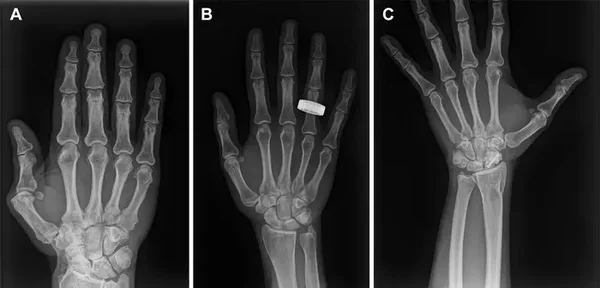
Last year, astronauts in orbit took diagnostic x-rays of their own bodies for the very first time—and now, we get to see the results.
On March 31, 2025, a SpaceX Falcon 9 rocket launched the Fram2 mission, which was the first human spaceflight to enter a polar orbit. The four people on board—cryptocurrency investor Chun Wang, film maker Jannicke Mikkelsen, engineer Rabea Rogge and polar explorer Eric Philips—spent three and a half days orbiting Earth.
During that time, they performed various science experiments, including taking x-rays of themselves. The results were published on Tuesday in Radiology.
On supporting science journalism
If you're enjoying this article, consider supporting our award-winning journalism by subscribing. By purchasing a subscription you are helping to ensure the future of impactful stories about the discoveries and ideas shaping our world today.
For four decades astronauts aboard spacecraft such as the International Space Station have had some seriously stocked medicine kits, including an ultrasound machine. But an x-ray machine was never part of that cache. That was partly because x-ray machines were too bulky to go to space, but new portable technology is making them more accessible.
“It’s been a dream for aerospace medicine to have more than one imaging modality for diagnosing illnesses and injuries in space,” said Sheyna Gifford, the study’s lead author and an assistant professor of aerospace medicine at Mayo Clinic, in a statement. “X-rays are fast, easy and diagnostically valuable.”
This matters because while NASA may be gearing up to send humans back to the moon for the first time in more than 50 years, the space agency’s long-term goal is a crewed mission to Mars. And as humans venture farther and for longer into space, they will need more diagnostic tools. Compared with ultrasound, x-ray scans are both easier and quicker to perform and assess with minimal training.
The Fram2 mission showed that x-rays are possible to collect in orbit and in microgravity, a feat some suspected would be difficult given the fact that it is hard to stay perfectly still in that environment. The researchers chose a portable, wireless system for the mission, and three of the crew got four hours of training on how to use it.

Representative preflight, in-flight, and postflight chest radiographs. Radiographs of the chest were acquired (A) preflight by a crewmember, (B, C) in-flight on day 3 after launch (L+3) by a crewmember, and (D) postflight by a non-crew operator using the same imaging protocol.
Radiological Society of North America (RSNA)
During the flight, the crew took images of a hand, forearm, abdomen, pelvis and chest. These were compared with preflight and postflight images of the same areas by radiologists, who found no difference in the overall quality of the x-rays. The researchers concluded the set-up could be used for diagnosis, according to the study.
X-rays could also be useful for looking inside equipment, Gifford pointed out. Indeed, the crew also tried out x-raying a smartwatch.
“A spaceflight-ready radiography system would have profound implications not only for crew health but also for mission-critical nonmedical tasks,” Gifford said. “For sustained human presence in space, X-rays are critical not just for crew members but also for other mission components like electronics and spacesuits. The only way to look inside these objects without taking them apart is to X-ray them.”