
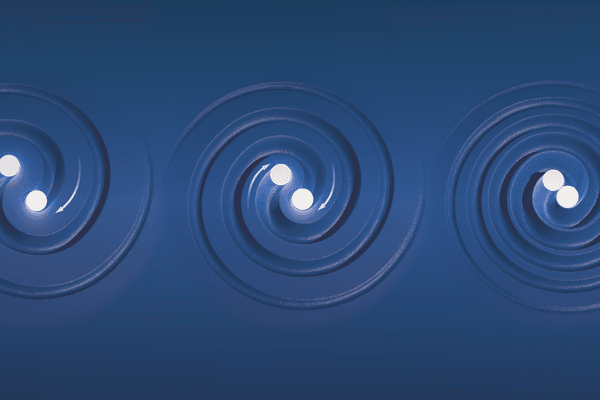
Since gravitational waves were first detected, in 2015, physicists have found almost 400 of these undulations in the fabric of spacetime. A new catalog of the findings, released this year, includes waves made by the collision of the heaviest pair of black holes seen yet, plus ripples from a set of black holes that were spinning at about 40 percent of the speed of light before they smashed together.
The collective findings come from a trio of gravitational-wave detectors: the U.S.-based Laser Interferometer Gravitational-Wave Observatory (LIGO), the Virgo interferometer in Italy, and the Kamioka Gravitational Wave Detector (KAGRA) in Japan.
Albert Einstein predicted gravitational waves in 1916, shortly after publishing his general theory of relativity, which describes how gravity molds the shape of space around mass. The collision of massive bodies such as black holes and neutron stars produces such extreme warping of spacetime that the effects are discernible millions or sometimes billions of light-years away.
On supporting science journalism
If you're enjoying this article, consider supporting our award-winning journalism by subscribing. By purchasing a subscription you are helping to ensure the future of impactful stories about the discoveries and ideas shaping our world today.
Researchers are using gravitational waves to test Einstein’s theory of gravity in the hope of eventually finding cracks that point toward a deeper theory.

Lucy Reading-Ikkanda

Lucy Reading-Ikkanda