
The window is quickly closing for members of the public to weigh in on proposed federal rule changes that, many scientists say, would politicize which studies get funded and profoundly harm American science.
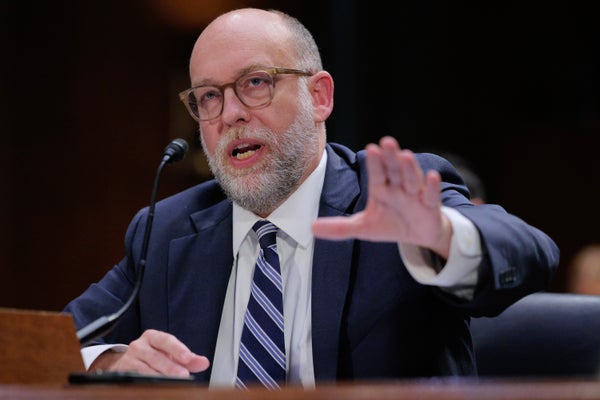
If enacted, the new rule would alter Office of Management and Budget (OMB) regulations to give political appointees in scientific agencies, rather than the current panels of peer reviewers that represent their fields, the power to choose which grant proposals are approved. When a draft of the changes was released in May, the OMB—led by Russsell Vought, architect of the Heritage Foundation’s Project 2025—justified them by saying federal awards had been used to promote a “woke” agenda under the Biden administration.
With the public comment period closing at midnight on July 13, prominent scientific associations have asked their members to weigh in. Scientists and science advocates have answered that call, leaving almost 300,000 comments so far. According to one analysis of the about 51,000 comments that were left as of July 9, 94 percent opposed the changes.
On supporting science journalism
If you're enjoying this article, consider supporting our award-winning journalism by subscribing. By purchasing a subscription you are helping to ensure the future of impactful stories about the discoveries and ideas shaping our world today.
Several Nobel laureates have been among those railing against the proposed changes. Physicist Wolfgang Ketterle of the Massachusetts Institute of Technology, who was among the recipients of the 2001 Nobel Prize in Physics for his work on Bose-Einstein condensates, wrote in his comment that the new regulations would “destroy the leadership of the U.S. in fundamental science.”
“For the future of our nation, we need exploratory research without alignment with administration policies and priorities,” he wrote. “I work on quantum science which is NOW a priority of the administration. But it took twenty years to develop the foundations, before it became clear that this can lead to novel quantum technologies.”
Martin Chalfie, a 2008 Nobel laureate in chemistry and a professor at Columbia University, said in his own comment that the bureaucratic infrastructure of science that has been in place in the U.S. since World War II “increased lifespan and healthspan, and has enabled discoveries that will continue to benefit the country.”
“My Nobel Prize–winning research was made possible by a peer-reviewed grant from [the National Institutes of Health], as have the work by so many others,” he added. “Having grants pass a political litmus test will destroy science.”
Alongside individuals, scientific associations and advocacy groups have criticized the changes. Elizabeth Jacobs, a professor emerita at the University of Arizona and coordinating committee member of Defend Public Health said in a statement that the proposed rule “terrifies me.”
“Any administration of any party might get offended at one of our state’s leaders,” she said. “Would that cause us to lose urgently needed funds, funds that our tax dollars support, for our schools or to help us recover from a disaster? That’s literally crazy. This could turn everything into a political football. This is an emergency, and we’re treating it like one.”
The effects of the changes would not be felt solely in the scientific community but would have impacts on the day-to-day lives of Americans, the American Meteorological Society said in its own statement. The association said recipients of federal funding would be restricted in their communications to the public, have a harder time attending international conferences where they could engage with the private sector and face more difficulty in publishing their findings.
The new regulations would “damage the nation’s ability to understand, predict, and respond to severe weather, drought, and other natural hazards with negative impacts on public safety and the economy,” the organization added.
Sidelining scientific experts in the grant decision-making process would also kneecap the ability of researchers to pursue work that could lead to improvements to Americans’ health, the American Association for Cancer Research (AACR) said in a statement.
“For decades, the framework that supports America’s scientific research enterprise through agencies such as NIH and the National Cancer Institute has fueled transformative discoveries in cancer prevention, detection, treatment, and survivorship,” the AACR wrote. “This established system has reduced the U.S. cancer death rate by 35% since 1991, resulting in more than 4.8 million U.S. lives saved. This progress has been made possible because of research funding decisions guided by the rigorous review of grant applications by scientific experts and their assessment of these grants to improve public health—NOT guided by political and ideological considerations.”