
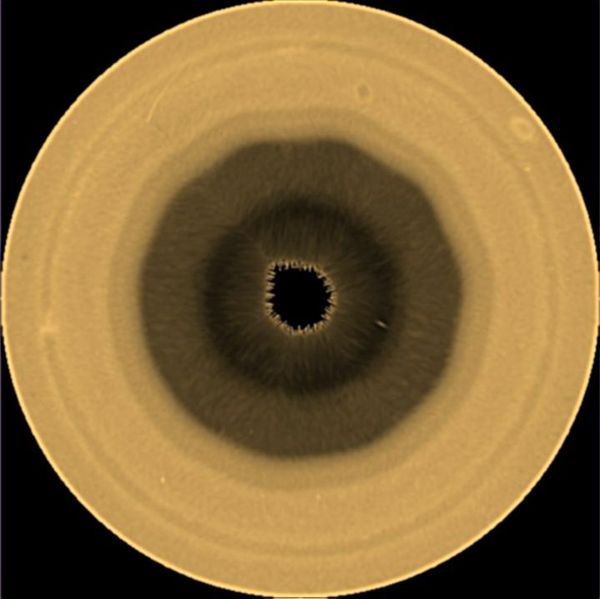
Scientists are baffled after discovering a weird decagon-shaped wave in the atmosphere of the planet Saturn. The 10-sided phenomenon appears to have formed over the planet’s south pole recently, but no one is quite sure why.
Nothing in Earth’s atmosphere compares to this wave, says Agustín Sánchez-Lavega, a physicist at Spain’s Bilbao School of Engineering. Why it has formed around Saturn’s south pole is an enigma, but it could be the result of disturbances in gas flows, possibly linked to a nearby storm with a high pressure center similar to Jupiter’s Great Red Spot.
“We do not yet know for certain,” Sánchez-Lavega says. “There is no single model to explain it. It may be the result of an instability in the jet stream in which it is situated or a wave forced from deeper levels of the atmosphere.”
On supporting science journalism
If you're enjoying this article, consider supporting our award-winning journalism by subscribing. By purchasing a subscription you are helping to ensure the future of impactful stories about the discoveries and ideas shaping our world today.
The wave is described in a new study that was published on Wednesday in Science Advances.
This isn’t the first unusual wave scientists have seen in Saturn’s atmosphere. In the 1980s, astronomers detected an hexagonal wave—a six-sided shape—over the planet’s north pole. While it was theorized that a similar wave may be present over the south pole, the decagon seems to have formed more recently. Older imaging by the Hubble Space Telescope and NASA’s Cassini probe don’t show any such structure.
In fact, it wasn’t until 2023 that Hubble photographs showed the wave taking shape. It became more and more defined until it appeared fully developed in images taken in August and September 2025, according to the new research.

Polar projections of Saturn’s southern hemisphere at two wavelengths: red at 763 nm and a methane absorption filter at 889 nm. The decagon is indicated by a yellow arrow. The dashed lines show the circles of latitude in blue, with their values indicated. The images were obtained the Hubble Space Telescope on August 29, 2025.
NASA/ESA/A. Sánchez-Lavega/Basque Country University (EHU)
“If the seasonal insolation cycle over the southern polar region plays a role in the formation of this structure, it may well become more pronounced in the coming years, when insolation reaches its peak at the latitude of the decagon around the year 2032,” says Sánchez-Lavega, who is lead author of the new study.
Whatever the wave is, it is likely to change. Looking closely at the images, some of the lines of the decagon appear quite fuzzy, which leads Sánchez-Lavega to believe the wave is unstable or still evolving. An added enigma is why such features have only been spotted on Saturn and not on Jupiter, another large, gaseous planet that is known for its stormy weather.
“What causes one hemisphere to have six sides and the other 10—perhaps this is related to the difference in latitude between the two cases,” he says. “There are many unanswered questions, which we hope future observations and models will help to clarify.”