
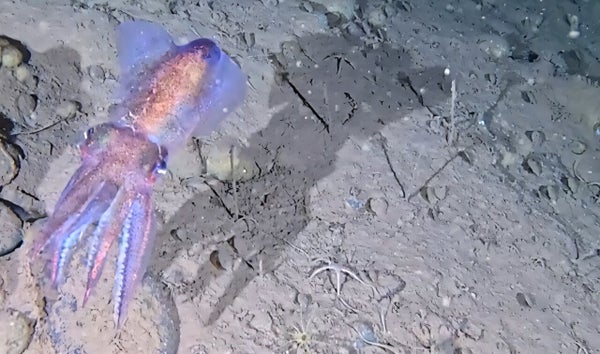
The Arctic Ocean is one of the most extreme environments on Earth, but that’s not stopping one cephalopod from making a home there. In a first, researchers observed an Arctic bobtail squid in the North Atlantic. The team captured video of a mature female squid tending her eggs.
The video shows that this species can reproduce and raise its young in one of the coldest, least-studied oceans on Earth.
The finding “highlights the resilience of marine life in one of Earth’s most extreme environments,” said Paige Maroni, a researcher at the University of Western Australia, in a statement. Maroni led the study, which was published in Polar Biology.
On supporting science journalism
If you're enjoying this article, consider supporting our award-winning journalism by subscribing. By purchasing a subscription you are helping to ensure the future of impactful stories about the discoveries and ideas shaping our world today.
The sighting occurred in Northeast Greenland National Park, the largest national park on Earth and also one of the least explored.
Maroni and her colleagues deployed a remotely operated underwater vehicle to a depth of 50 meters when it spotted the squid and her eggs—at this depth, the water was –1.6 degrees Celsius (29.12 degrees Fahrenheit).
In Arctic ecosystems, squid and octopuses occupy a special place, both hunting smaller prey and getting hunted themselves, and this makes them a sensitive early signal of how the broader ecosystem is holding up as the region warms.
“Establishing knowledge of the biodiversity in this region is crucial for understanding ecosystem function and resilience under accelerating climate change,” Maroni said. “This study provides a valuable new baseline for tracking ecological change in the rapidly warming Arctic.”
The expedition itself has pointed to a broader shift in how this kind of research gets done. The team wasn’t onboard a dedicated research vessel. Rather the researchers were on a Secret Atlas Expedition Micro Cruise ship, supported by Yachts for Science, a model that pairs paying travelers with working scientists. Maroni said that pairing is proving to be more than a novelty.
“Our results show low-impact science and expedition tourism can help fill major biodiversity gaps in remote polar regions,” she said. “In poorly studied polar ecosystems, even one verified observation can provide important insight into species distributions, reproduction and resilience under climate change.”