
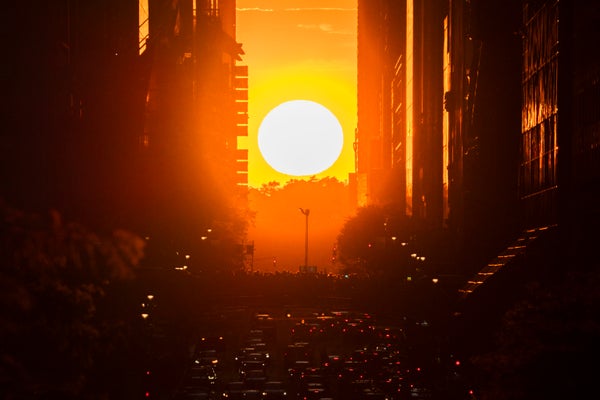
New York City loves an exclusive. And on just four evenings every year, Manhattan is treated to an iconic sunset display: Manhattanhenge.
On these special days, the sun’s light lines up perfectly with Manhattan’s East-West grid streets as it drops towards the horizon, causing it to appear centered among the corridors of skyscrapers.
The phenomenon is one of New York City’s most anticipated astronomical spectacles. It happens on two days in late May and two days in mid-July—although just one of the July dates will reveal the entire sun framed between skyscrapers. Here’s everything you need to know about the coming Manhattanhenge.
On supporting science journalism
If you're enjoying this article, consider supporting our award-winning journalism by subscribing. By purchasing a subscription you are helping to ensure the future of impactful stories about the discoveries and ideas shaping our world today.
Where Did “Manhattanhenge” Come From?
Astrophysicist and television personality Neil deGrasse Tyson claims to have coined the term Manhattanhenge. The monicker is an apparent nod to Stonehenge, an ancient British monument which may have acted as a solar calendar and was the likely site of ancient rituals celebrating the solstice.
But unlike its namesake, Manhattanhenge has no celestial function. Instead, it is a happy accident of the Commissioners’ Plan of 1811, which rotated Manhattan’s street grid about 29 degrees east of true north , to follow the island's natural orientation.
More than two centuries and many skyscrapers later, that decision is what makes Manhattanhenge possible.
Although we’re taught that the sun rises due east and sets due west, that’s only completely true twice a year, during the spring and fall equinoxes. For the rest of the year, the points at which the sun rises and sets slowly migrate along the horizon as the Earth orbits around the star. Twice each year, those points more or less align with Manhattan’s street grid.
How to See Manhattanhenge
Manhattanhenge will occur on Saturday, July 11 and on Sunday, July 12. On Saturday, viewers will see the entire glowing orb of the sun perfectly framed by buildings on either side at around 8:20 P.M. EDT. On Sunday, viewers will see just half the sun framed in such a way, at about 8:21 P.M. EDT.
For the best view of Manhattanhenge, head to one of Manhattan’s wide east-west streets that has an unobstructed view of the New Jersey horizon. The American Museum of Natural History’s Hayden Planetarium recommends 14th, 23rd, 34th, 42nd and 57th Streets. Of these options, 34th and 42nd offer especially striking views depending on where you are along the street, as the sun can be framed by the Empire State and Chrysler Buildings. It’s best to arrive at least 20 to 30 minutes early: the alignment lasts only a few minutes, and the best viewing spots fill up quickly. A partly cloudy forecast isn’t necessarily a dealbreaker. As long as the western horizon remains mostly clear and any clouds stay high overhead, you still have a good chance of catching the alignment. The moment may be brief, but it offers a rare reminder that even in the middle of one of the world’s busiest cities, the cosmos can stop you in your tracks.
