
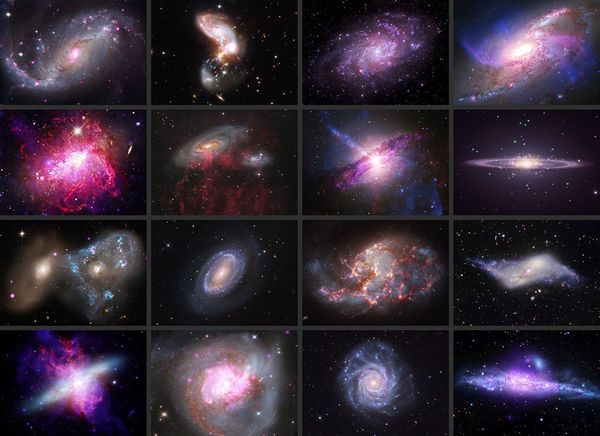
NASA’s Chandra X-ray Observatory just dropped a new cache of photographs that capture the stunning beauty of different types of galaxies across the universe.
The 16 images include x-ray data that Chandra has collected over decades, combined with observations from other telescopes in space and across the world. These cosmic behemoths can tell us more about our own Milky Way galaxy’s history and the universe’s evolution over time.
NASA’s Chandra, launched in 1999, is the highest-resolution x-ray telescope in orbit and has captured everything from epic colliding galaxies to weird, dead stars.
On supporting science journalism
If you're enjoying this article, consider supporting our award-winning journalism by subscribing. By purchasing a subscription you are helping to ensure the future of impactful stories about the discoveries and ideas shaping our world today.
Some of the images feature spiral galaxies, which have a concentration of stars in their center and “arms” that resemble a pinwheel—the Milky Way is a spiral galaxy.

NASA/CXC/SAO; copyright © 2011-2015 R Jay GaBany/Cosmotography.com (optical); NASA/CXC/SAO/L. Frattare (image processing)
The NGC 4631 galaxy, the spiral galaxy above, photographed from its side, has been nicknamed the “Whale Galaxy” because of its shape at this angle.
Other images reveal elliptical galaxies, which don’t have extending arms or much structure at all. These galaxies tend to include older stars and can grow larger than any other type of galaxy. The galaxy featured next, M104, is actually a mix of elliptical and spiral galaxies and is known as the “Sombrero Galaxy.”

NASA/CXC/SAO (x-ray); NASA/Hubble Heritage Team/AURA/STScI (optical); NASA/ESA/CSA/STScI (infrared); NASA/CXC/SAO/L. Frattare (image processing)
The final group featured in the gallery are irregular galaxies, which, as the name suggests, can come in all shapes and sizes.

NASA/CXC/SAO (x-ray); NASA/ESA/STScI/J. Dalcanton (optical); NASA/CXC/SAO/L. Frattare (image processing)

NASA/CXC/SAO (x-ray); NASA/ESA/STScI (optical); NASA/ESA/CSA/STScI (infrared); NASA/CXC/SAO/L. Frattare/J. Major (image processing)
The images also provide clues into the transformations and collisions that shape galaxies, such as waves of stellar births and supermassive black holes. Both galaxy pairs featured above, Arp 143 and II Zw 096, highlight mergers and collisions between galaxies.