
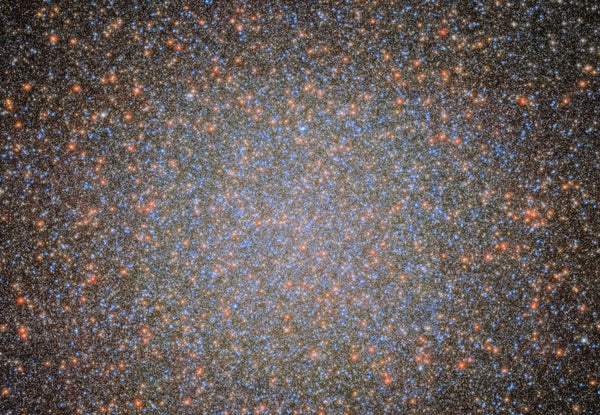
Scientists have detected a small black hole hiding inside one of the Milky Way’s massive star clusters, Omega Centauri. Researchers believed the cluster to be teeming with stellar-mass black holes, but until now, they had remained elusive.
Researchers pored over more than 20 years of data from the NASA’s Hubble Space Telescope, as well as more recent measurements from the agency’s James Webb Space Telescope. They looked for subtle movements of individual stars within Omega Centauri, which lies approximately 17,700 light-years away from Earth and contains some 10 million stars.
One star in particular stuck out to the researchers. It appeared to be circling an object with a mass much larger than its own—a telltale sign of a black hole.
On supporting science journalism
If you're enjoying this article, consider supporting our award-winning journalism by subscribing. By purchasing a subscription you are helping to ensure the future of impactful stories about the discoveries and ideas shaping our world today.
The black hole, called oMEGACat BH-2, is about 4.46 times the mass of the sun, according to the analysis. While previous research had uncovered an “intermediate-mass” black hole at the center of Omega Centauri, oMEGACat BH-2 is the first of potentially many smaller black holes known as stellar-mass black holes to be found in the star cluster.
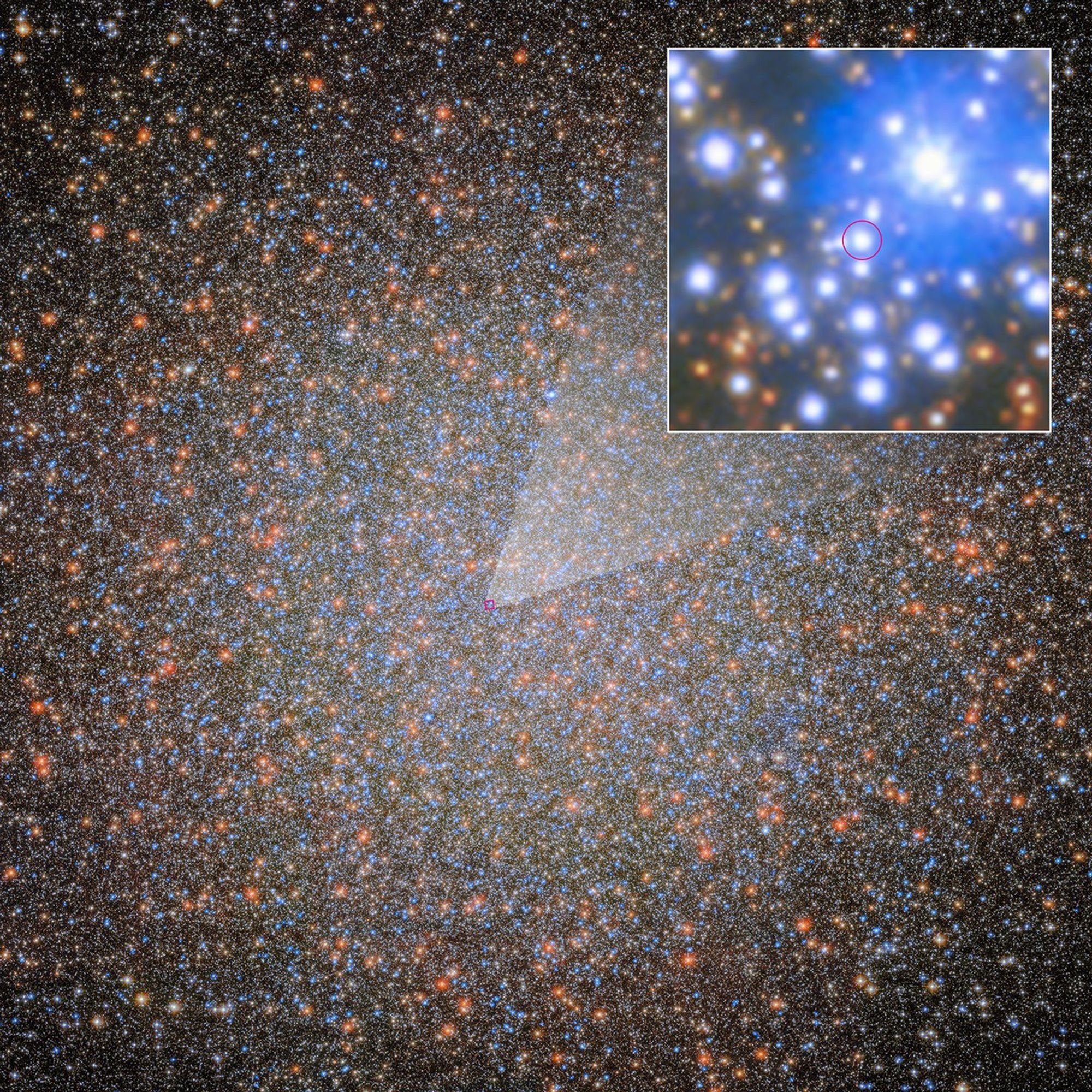
Omega Centauri’s first stellar-mass black hole.
“We’ve long suspected that Omega Centauri contains a large population of stellar-mass black holes, but this is the first time we’ve been able to detect one, giving us confidence that we may be able to detect others,” says Matthew Whitaker, lead author of the study and a research assistant at the University of Utah, Salt Lake City.
The star orbiting oMEGACat BH-2 takes about 94 years to complete its loop, the longest orbital period of any black hole–star system ever recorded, the researchers write.
“For me, this discovery represents one of the first few drops in what may soon be a steady stream of discoveries using this same method,” Whitaker says.
Whitaker expects that more black hole–star pairs throughout the Milky Way will turn up in future data releases from the European Space Agency’s Gaia Space Observatory. And “an even larger number” could be found with the forthcoming Nancy Grace Roman Space Telescope, which will image the sky “with Hubble-like precision.”
The findings were published on Monday in the Astrophysical Journal Letters.