
NASA’s Psyche spacecraft is on its way to a metal-rich asteroid beyond Mars—and it’s enjoying the scenic route.
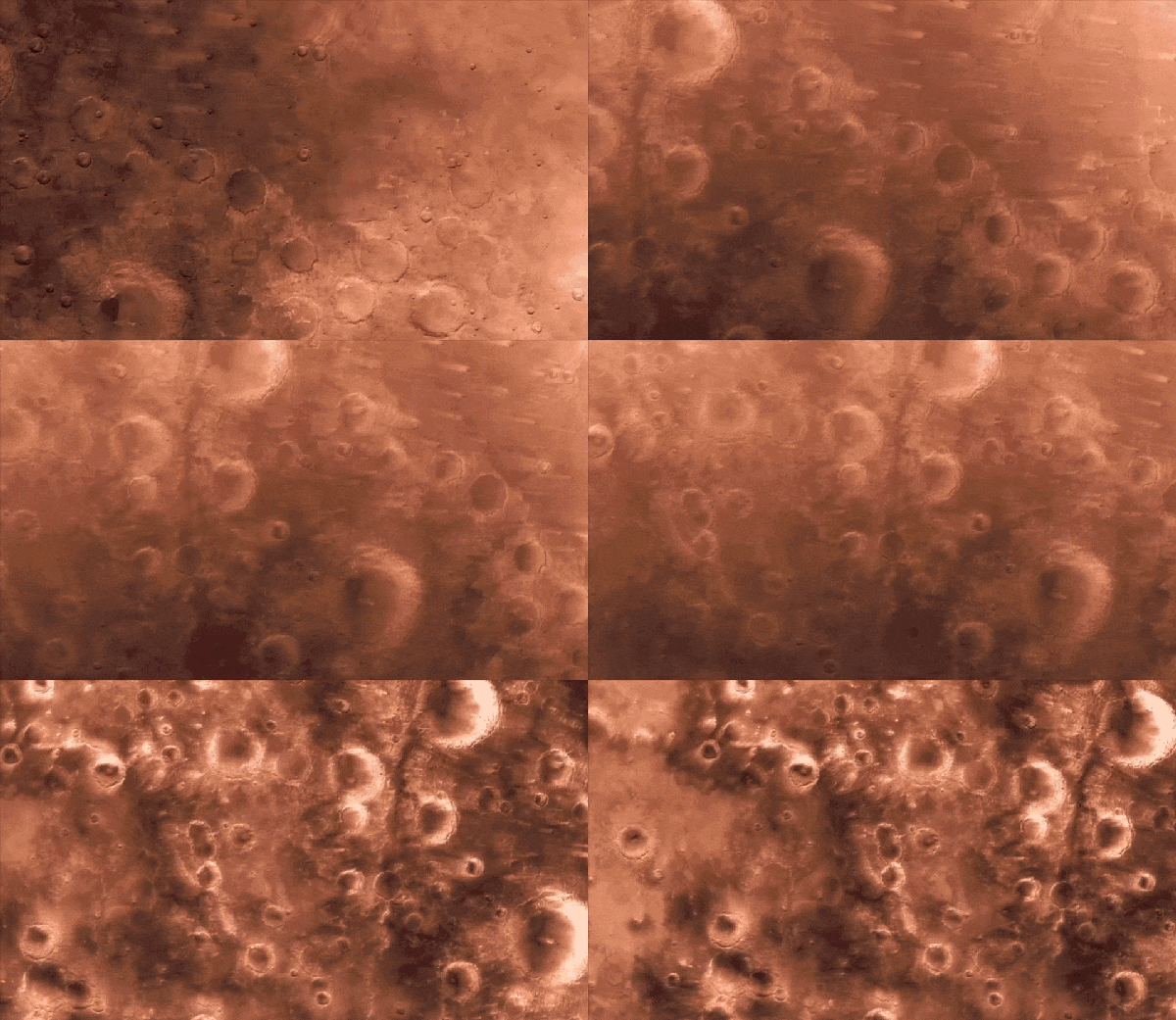
In a flyby maneuver earlier this year, Psyche used the planet’s gravity to reshape its trajectory, all while capturing images that NASA has stitched into a mesmerizing time-lapse video.
This time-lapse video shows the approach and departure of NASA’s Psyche spacecraft at Mars as it used the planet’s gravity for a boost on its way to the asteroid Psyche.
On supporting science journalism
If you're enjoying this article, consider supporting our award-winning journalism by subscribing. By purchasing a subscription you are helping to ensure the future of impactful stories about the discoveries and ideas shaping our world today.
The sequence opens with the faint crescent of Mars growing steadily larger before gliding over the planet’s sweeping ocher vistas. The surface is pockmarked with impact craters. Gleaming polar ice caps shine in the sun’s light. The series culminates in a close pass over the planet that was taken before the Psyche spacecraft slipped into interplanetary space.
Launched in 2023, the Psyche mission is headed for an asteroid that scientists suspect may be the exposed nickel-iron core of an early planet, stripped bare by violent collisions during the solar system’s youth.
As Mars’s gravity slung the spacecraft onto the next leg of its journey, mission scientists used the opportunity to put its multispectral imager through a full dress rehearsal.
“The imager performed brilliantly,” said Jim Bell, the Psyche imager instrument lead at Arizona State University, in a statement.
“We were also able to fully test its calibration and sensitivity to scattered light, including picking out the Martian moons Phobos and Deimos from very far away as a part of a practice for the satellite search that we’ll use at the asteroid Psyche to look for any moonlets there.”
Already three years into its journey, the Psyche spacecraft still has three more to go until it reaches its destination. If all goes according to plan, the spacecraft will arrive at the asteroid in 2029.