New Issue: Orbital Catastrophe Ahead? Read Now

Largest galaxy survey yet confirms that the Universe is not clumpy enough

The six-year results from the Dark Energy Survey highlight unresolved tensions in standard cosmological theory

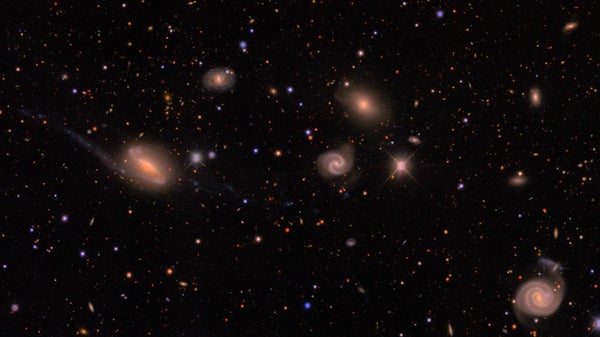
The image shows just a tiny part of one image captured by the Dark Energy Camera

The Dark Energy Survey observed around 150 million galaxies visible in Earth’s southern sky.

Erin Sheldon and the Dark Energy Survey Collaboration

Join Our Community of Science Lovers!

Astronomers have released the most ambitious cosmic map assembled so far, confirming that matter in the Universe is less clumpy than standard cosmological theory would predict.

From 2013 to 2019, the Dark Energy Survey (DES) team repeatedly imaged a large section of Earth’s southern sky to collect the positions, colours and shapes of around 150 million galaxies. Using a telescope at the Cerro Tololo Inter-American Observatory in Chile, the team also detected and studied more than 1,500 supernova explosions of a type that can be used to track the expansion history of the Universe.

The team analysed four different aspects of the data: the brightness and other characteristics of the supernovae; the clustering of galaxies across space and time; the evolving size of remnants of pressure waves generated in the Universe’s infancy; and the distortion of images of background galaxies by large concentrations of intervening invisible ‘dark matter’.


On supporting science journalism

If you're enjoying this article, consider supporting our award-winning journalism by subscribing. By purchasing a subscription you are helping to ensure the future of impactful stories about the discoveries and ideas shaping our world today.


The combined results refine previous DES measurements to confirm that gravity has not clumped galaxies together as much as as much as observations of the early Universe would lead us to anticipate, were the standard theory of the Universe's evolution correct — an ongoing puzzle for cosmologists.

This article is reproduced with permission and was first published on January 30, 2026.

First published in 1869, Nature is the world's leading multidisciplinary science journal. Nature publishes the finest peer-reviewed research that drives ground-breaking discovery, and is read by thought-leaders and decision-makers around the world.

More by Nature magazine

Subscribe to Support Independent Journalism

Great science journalism requires human expertise, time, effort and creativity. And it costs money. That’s why I and the journalists here at Scientific American hope you’ll join our community.

When you subscribe, you are supporting staff and freelance journalists who are passionate about telling science stories that are true, important and compelling. Our editors and reporters are often experts in their fields, which means they understand the nuances of big discoveries and can untangle the breakthroughs from the hype. With a subscription, you are also supporting rigorous fact-checking to ensure the words we publish are precise and accurate. And you’re supporting original illustrations, graphics and photos that bring you closer to an advanced laboratory, an ice sheet in Antarctica or a space mission in orbit. You’re helping us craft other types of high-quality journalism as well: Our newsletters are carefully written, edited and curated by staffers you have or will come to know and love. Our Science Quickly podcast is based on original reporting, collaboration with editors and scientists and exacting production.

Subscriptions keep this engine running so we can continue to deliver thoughtful, rigorous and independent science journalism to you. In an era of viral misinformation, this work is crucial. If you value what we do, I hope you’ll consider joining us as a subscriber

Thank you,

Jeanna Bryner, Editor in Chief, Scientific American

Subscribe