
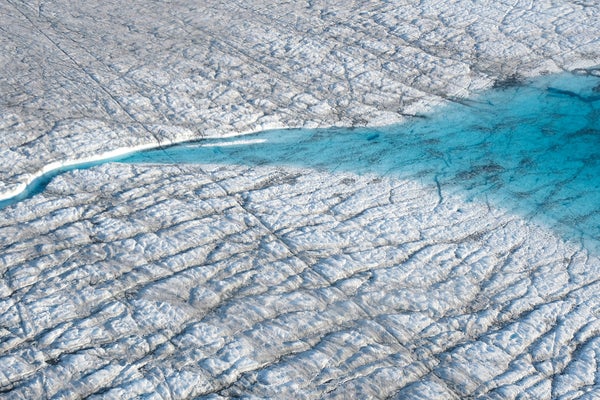
The vast Greenland ice sheet is melting at some of its fastest rates in the past 12,000 years. And it could quadruple over the next 80 years if greenhouse gas emissions don’t decline dramatically in the coming decades.
Research published yesterday in the journal Nature warns that the ice sheet’s future losses depend heavily on how quickly humans cut carbon emissions today.
Led by Jason Briner of the University at Buffalo, State University of New York, the study is among the first to compare the possible future of the ice sheet with its ancient past.
On supporting science journalism
If you're enjoying this article, consider supporting our award-winning journalism by subscribing. By purchasing a subscription you are helping to ensure the future of impactful stories about the discoveries and ideas shaping our world today.
“Now we’re really able to put into perspective just how anomalous our current change is and future changes might be,” said Josh Cuzzone, a co-author of the study and a scientist at the University of California, Irvine.
The researchers used models, informed by data from ancient ice samples drilled out from the ice sheet, to reconstruct a history of Greenland spanning the past 12,000 years. They also used models to predict how the ice sheet might change under different climate scenarios—assuming both higher and lower levels of greenhouse gases—through the rest of this century.
The findings were concerning.
Before the industrial era, the highest rates of Greenland ice loss in 12,000 years were around 6 trillion tons of ice in a single century. That’s similar to the rate at which ice is melting in Greenland today.
As the climate continues to warm, those rates are expected to increase. How much depends on how fast the climate warms.
The researchers examined two possible future climate scenarios. The first assumes that humans manage to keep global temperatures within about 2 degrees Celsius of their preindustrial levels—the major goal of the international Paris climate agreement.
In this scenario, Greenland will likely still lose more than 8 trillion tons of ice over the course of this century—a faster rate than at any other point in the last 12,000 years.
The second scenario assumes high rates of greenhouse gas emissions, similar to today’s emissions, for the rest of the century. If that happens, the models suggest the ice sheet could lose 14 trillion to 36 trillion tons of ice over the course of this century.
Researchers are now “increasingly certain that we are about to experience unprecedented rates of ice loss from Greenland, unless greenhouse-gas emissions are substantially reduced,” Andy Aschwanden, a researcher at the University of Alaska, Fairbanks, said in a commentary on the research also published yesterday in Nature.
The amount of future ice loss could make a big difference to communities around the world through its effect on sea levels.
Greenland is already the biggest contributor to global sea-level rise. And the difference in 20 trillion or 30 trillion extra tons of ice between now and the end of the century could amount to several centimeters of sea-level rise around the world.
That may not sound like much, but it could make a dramatic difference in the amount of flooding experienced by coastal cities.
There are other consequences as well. The influx of cold, fresh meltwater pouring into the sea could have far-reaching effects on the structure and flow of ocean currents and the way they exchange heat with the atmosphere. That could affect weather patterns around the world.
The new study reiterates that preventing the worst of these consequences requires swift, stringent efforts to reduce global carbon emissions today.
“It does show that, at least with these scenarios and this ice sheet model, that if we cut back on our carbon emissions we can avoid the worst case that we’re kind of heading toward currently,” Cuzzone said.
Reprinted from Climatewire with permission from E&E News. E&E provides daily coverage of essential energy and environmental news at www.eenews.net.