
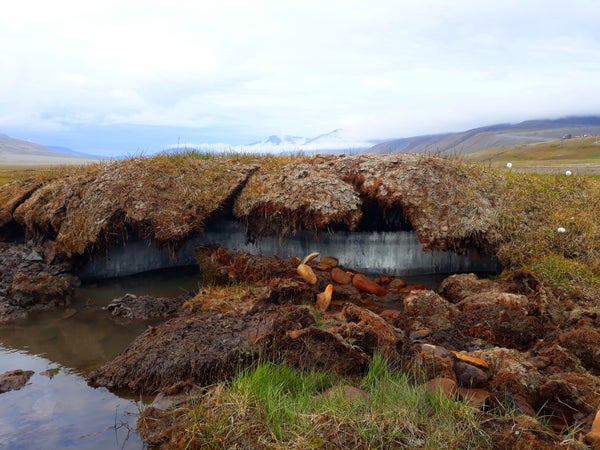
Permafrost, or frozen soil, covers some 15 percent of land in the Northern Hemisphere, and thanks to human-driven climate change, it is fueling a vicious warming feedback loop. As rising global temperatures melt the frozen soil, it releases stored carbon into the atmosphere, enhancing warming. Scientists have debated for years how fast this could happen and how much carbon the world’s permafrost might expel, but according to a new study, the situation might be far worse than past estimates suggest.
We know that permafrost stores a massive amount of carbon: In the Northern Hemisphere, it holds around double the carbon that’s already in the atmosphere, according to the National Oceanic and Atmospheric Administration. For thousands of years, permafrost has been a reliable carbon “sink”—meaning it has trapped carbon—mostly in the form of frozen organic matter such as dead plant and animal material. Because of warming, northern permafrost could soon release more carbon than it stores, turning it into a carbon source.
In the new study, researchers estimate that that tipping point could happen by 2100—earlier than previous models suggest.
On supporting science journalism
If you're enjoying this article, consider supporting our award-winning journalism by subscribing. By purchasing a subscription you are helping to ensure the future of impactful stories about the discoveries and ideas shaping our world today.
The reason has to do with frozen soils deep below the surface. While other projections have largely focused on permafrost near the surface, where most of the carbon is stored, the new study accounts for deeper soils. These soils lie beyond a depth of three meters, or about 10 feet, explains Yi Xi, the study’s first author and a postdoctoral researcher at the Laboratory for Climate and Environmental Sciences in France. The results suggest that these deeper soils may be an overlooked source of carbon.
“In our model, we constructed the accumulation history of soil carbon below three meters,” Xi says, such as peatlands that formed during the Holocene. Then, using various global warming scenarios projected by the United Nations’ Intergovernmental Panel on Climate Change (IPCC), she and her co-authors found that without a reduction in global temperatures, melting northern permafrost could emit much more carbon before the end of the century than previously thought.
“Deep permafrost has been an under-appreciated component of Earth system models, so it's great to see more explicit treatment of this important [carbon] reservoir in model simulations,” says Alberto Reyes, an associate professor at University of Alberta who studies the North American permafrost. Reyes was not involved in the new study.
“This will be a necessary first step as the community works to better assess the fate of permafrost and associated climate feedbacks during past periods of climate warming during the Pleistocene,” he adds.
“This study helps close an important modeling gap—models used to inform climate policy haven’t fully captured permafrost processes, including the deep carbon stores locked in permafrost," says Susan Natali, an Arctic climate scientist at the Woodwell Climate Research Center, who was not involved in the new study.
There may be some good news buried in the findings, Xi says: by understanding how “deep carbon” could fuel climate change, the world can be better prepared to address the problem. “It can be an alarm for us,” she says. “Maybe the remaining carbon budget will be recalculated,” she adds, referring to the U.N. threshold of greenhouse gases the world can emit before hitting 1.5 or two degrees Celsius of warming above preindustrial levels.
Those calculations are ongoing: the IPCC is currently working on its seventh major report on climate change, including projections on permafrost. It is slated to be released by the end of 2029.
“Fully assessing and accounting for permafrost carbon emissions, which are being amplified by climate change, is critical for effective climate adaptation and mitigation planning and action,” Natali says.