This article is part of a special report on the total solar eclipse that offered the best views from the Arctic Circle, Iceland, Spain and parts of Portugal on August 12, 2026.
Join Our Community of Science Lovers!
The 2026 total solar eclipse has come and gone, but that doesn’t mean the wonder has to end.
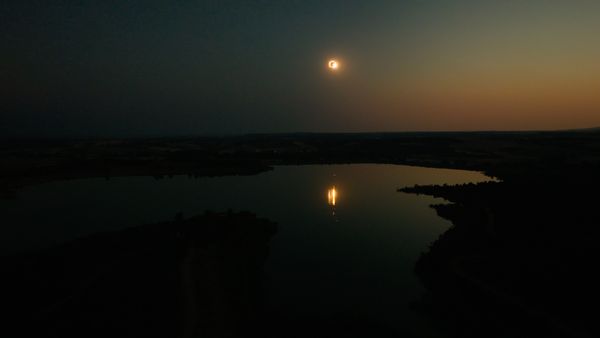
Scientific American contributor and eclipse chaser Lucie McCormick watched the eclipse unfold from central Spain, where she recorded and photographed the event with a drone, as well as ground-based cameras. Using those drone-captured images, McCormick has created a stunning time-lapse video showing the eclipse from beginning to end.
In the time lapse, the setting sun disappears behind the moon as our natural satellite moves directly in front of the star. During this period of totality—which had lasted just more than a minute in real time—you can see the entire landscape plunged into darkness, leaving only a halo of orange light in the sky.
On supporting science journalism
If you're enjoying this article, consider supporting our award-winning journalism by subscribing. By purchasing a subscription you are helping to ensure the future of impactful stories about the discoveries and ideas shaping our world today.
To learn more about this solar eclipse, read our full eclipse guide. And if you feel inspired to try and catch the next one yourself, check out McCormick’s tips and tricks for safely photographing an eclipse using any camera.
Subscribe to Support Independent Journalism
Great science journalism requires human expertise, time, effort and creativity. And it costs money. That’s why I and the journalists here at Scientific American hope you’ll join our community.
When you subscribe, you are supporting staff and freelance journalists who are passionate about telling science stories that are true, important and compelling. Our editors and reporters are often experts in their fields, which means they understand the nuances of big discoveries and can untangle the breakthroughs from the hype. With a subscription, you are also supporting rigorous fact-checking to ensure the words we publish are precise and accurate. And you’re supporting original illustrations, graphics and photos that bring you closer to an advanced laboratory, an ice sheet in Antarctica or a space mission in orbit. You’re helping us craft other types of high-quality journalism as well: Our newsletters are carefully written, edited and curated by staffers you have or will come to know and love. Our Science Quickly podcast is based on original reporting, collaboration with editors and scientists and exacting production.
Subscriptions keep this engine running so we can continue to deliver thoughtful, rigorous and independent science journalism to you. In an era of viral misinformation, this work is crucial. If you value what we do, I hope you’ll consider joining us as a subscriber
Thank you,
Jeanna Bryner, Editor in Chief, Scientific American