Dog Genetics Reveal Surprising Relationships among Breeds

When it comes to dog traits, genetics-based lineages are more telling than human-made categories

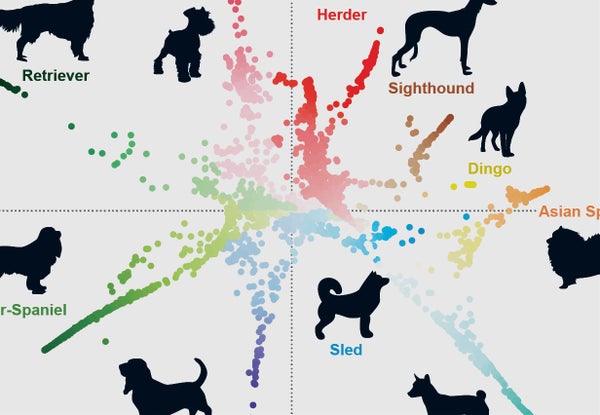
Detail of the main graphic, in which a scatterplot is punctuated with dog silhouettes and lineage names, including Herder, Sighthound and Dingo.

Emily V. Dutrow and MSJONESNYC

Join Our Community of Science Lovers!

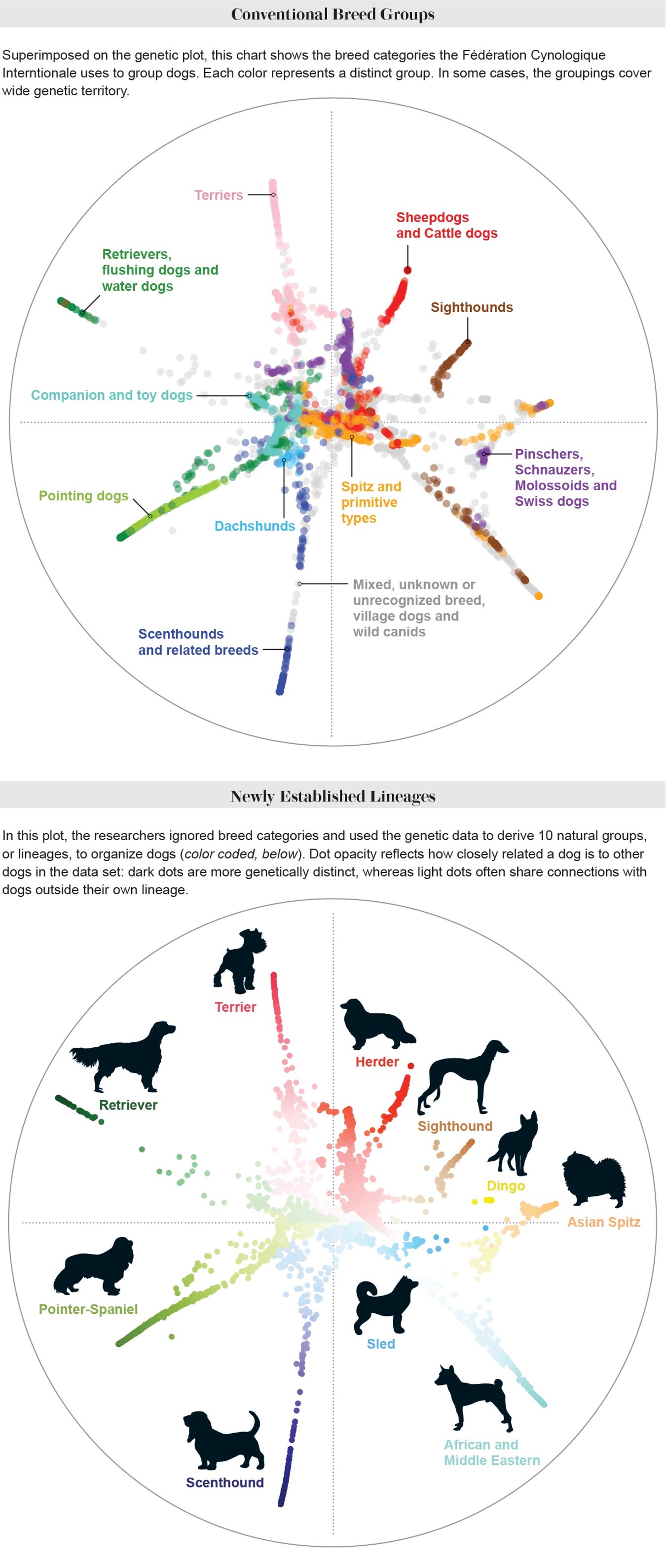
There are 356 unique breeds of dog, according to the Fédération Cynologique Internationale, the largest global organization of national kennel clubs. Yet understanding the genetic drivers for the behavioral traits that set these breeds apart has been a long-standing scientific challenge. In a recent study, scientists compiled DNA sequences for more than 4,000 domesticated and wild dogs to uncover the genetic connections between them and found that they sometimes defy the conventional, human-made breed categories. Instead of assuming that some breeds were related to others, the researchers found a new way to group dogs based on their genetics.

The analysis revealed that dogs fall into 10 “lineage” groups with close genetic connections. To see whether dogs in each lineage shared similar traits, the scientists combined their data with behavioral surveys filled out by the owners of around 46,000 purebred dogs. They found that many traits were common among members of each lineage and that certain genetic variants might be related to these traits. “We found a series of genes that turned out to be important in brain development in herding breeds,” says Elaine A. Ostrander of the National Human Genome Research Institute, a co-author on the study in Cell. “That's a great jumping-off point to study how herding dogs herd.”

These two plots show two different ways of categorizing dog breeds—one based on human-defined groupings and another based on “lineages” derived from genetic data. In both plots, each of the 4,000 dots represents an individual dog. Their positions (identical in both plots) reflect how closely genetically related they are to other dogs—two nearby dots are genetically similar, and two distant dots diverge more.


On supporting science journalism

If you're enjoying this article, consider supporting our award-winning journalism by subscribing. By purchasing a subscription you are helping to ensure the future of impactful stories about the discoveries and ideas shaping our world today.

Credit: Emily V. Dutrow and MSJONESNYC; Source: “Domestic Dog Lineages Reveal Genetic Drivers of Behavioral Diversification,” by Emily V. Dutrow, James A. Serpell and Elaine A. Ostrander, in Cell, Vol. 185; December 8, 2022 (reference)

Clara Moskowitz is chief of reporters at Scientific American, where she covers astronomy, space, physics and mathematics. She has been at Scientific American for more than a decade; previously she worked at Space.com. Moskowitz has reported live from rocket launches, space shuttle liftoffs and landings, suborbital spaceflight training, mountaintop observatories, and more. She has a bachelor’s degree in astronomy and physics from Wesleyan University and a graduate degree in science communication from the University of California, Santa Cruz.

More by Clara Moskowitz

Emily V. Dutrow is a geneticist interested in the evolution of complex traits. She is a postdoctoral fellow at the National Human Genome Research Institute of the National Institutes of Health where she studies canine behavioral diversification.

More by Emily V. Dutrow

MSJONESNYC (Heather Jones) is an award winning information and motion graphics designer based in Brooklyn. She enjoys exploring the world through graphics, using text, data, illustration, and motion. Her work can be found at msjonesnyc.com.

More by MSJONESNYC
Scientific American Magazine Vol 328 Issue 5This article was published with the title “The DNA of Dog Breeds” in Scientific American Magazine Vol. 328 No. 5 (), p. 88
doi:10.1038/scientificamerican0523-88

It’s Time to Stand Up for Science

If you enjoyed this article, I’d like to ask for your support. Scientific American has served as an advocate for science and industry for 180 years, and right now may be the most critical moment in that two-century history.

I’ve been a Scientific American subscriber since I was 12 years old, and it helped shape the way I look at the world. SciAm always educates and delights me, and inspires a sense of awe for our vast, beautiful universe. I hope it does that for you, too.

If you subscribe to Scientific American, you help ensure that our coverage is centered on meaningful research and discovery; that we have the resources to report on the decisions that threaten labs across the U.S.; and that we support both budding and working scientists at a time when the value of science itself too often goes unrecognized.

In return, you get essential news, captivating podcasts, brilliant infographics, can't-miss newsletters, must-watch videos, challenging games, and the science world's best writing and reporting. You can even gift someone a subscription.

There has never been a more important time for us to stand up and show why science matters. I hope you’ll support us in that mission.

Thank you,

David M. Ewalt, Editor in Chief, Scientific American

Subscribe