
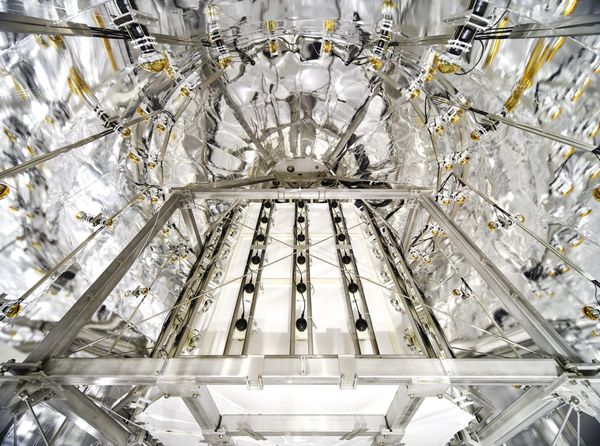
Several times over the past few years, deep beneath a mountain in central Italy, a neutrino, the lightest and most elusive particle we know, careened into an electron, producing a faint trickle of light. Fortunately, one of the most sensitive detectors ever constructed was buried there to catch that fleeting glow and record the neutrinos’ ghostly presence.
Today the XENON collaboration announced in a webinar that its experiment, XENONnT, has detected the faintest neutrino collisions ever witnessed. The result, which has less than a one in a million chance of being a statistical fluke, shows just how far physicists have come in their hunt for the missing chunk of the universe known as dark matter—and how far they still must go.
“This is an important milestone for contributing to the physics of low-energy neutrinos,” says Masatoshi Kobayashi, a physicist at Nagoya University in Japan, who co-led the analysis.
On supporting science journalism
If you're enjoying this article, consider supporting our award-winning journalism by subscribing. By purchasing a subscription you are helping to ensure the future of impactful stories about the discoveries and ideas shaping our world today.
Neutrinos, which are produced in the sun as well as other astrophysical sources and are constantly zipping through the Earth, are notoriously difficult to measure. A neutrino very rarely collides with any particle as it passes, and detectors have only caught those collisions when they’ve been violent enough to shine above the noise. Others have been far too quiet—producing only one billionth the energy of the proton-proton collisions at CERN’s Large Hadron Collider, the most powerful particle accelerator on Earth. These solar neutrinos are still traveling close to the speed of light, but their energy has been too low to register on any previous experiment’s instruments.
But XENONnT was able to see them because it’s been looking for something even more elusive. For decades, the XENON collaboration has been locked in an international race to find dark matter, which makes up an estimated 85 percent of the matter in the universe. Dark matter is thought to be made of particles that pass through us all the time but that are so inert that they’ve left no trace within the detection experiments that are scattered around the globe.
After decades of refinement, these experiments are now so sensitive that they can witness unprecedented phenomena—such as the rarest, faintest bang of a solar neutrino. To many researchers, this detection is really a warning of a dismal future. Before long, this march of technological progress will hit a wall: our observations will become swamped by solar neutrinos, making it impossible for us to pick out dark matter from their frequent background flashes. “This result shows we are really reaching the neutrino-equivalent background level,” Kobayashi says. Until then, at least, physicists are seeing something.
“We’re still chasing that dark matter signal, of course, but what we’ve found here is genuinely exciting,” says Luca Grandi, a professor at the University of Chicago and a member of XENON. “It’s a powerful sign of how far the technology has matured.”