
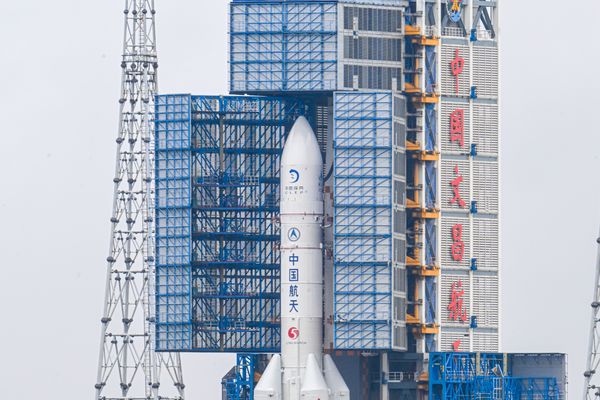
China’s lunar ambitions took a hit after the country called off the launch of a spacecraft that it has aimed to make the first to ever land on the moon’s south pole.
Chang’e 7 was supposed to launch onboard a Long March 5 rocket on August 24, but the launch was scrubbed on Sunday evening, China’s Manned Space Agency (CMSA) said in a statement. Poor weather conditions linked to Typhoon Narra were likely a factor. As a result, the mission will be put on ice until at least 2027.
The decision to delay the mission was reached after extensive review, the CMSA said, and reflects the need for “absolute safety.”
On supporting science journalism
If you're enjoying this article, consider supporting our award-winning journalism by subscribing. By purchasing a subscription you are helping to ensure the future of impactful stories about the discoveries and ideas shaping our world today.
China and the U.S. are in a race to send humans back to the moon, a feat that that U.S. accomplished in the 1960s and that has never been achieved by any other country. Chang’e 7 is to play to a crucial part in China’s ambitions: the probe is designed to search for frozen water in the Shackleton Crater, a pit that spans some 21 kilometers (13 miles) and sits beside the lunar south pole.
No spacecraft has ever landed in that region, which scientists consider to be among the likeliest places to find water on the moon. Locating water that can be used by humans is vital to establishing any long-term lunar presence. NASA and China are eyeing the region to establish a crewed base—and because this real estate is so precious, it matters who gets their first.
NASA plans to establish a lunar colony by 2036, while China hopes to begin construction of the International Lunar Research Station, a moon base built in collaboration with Russia, in 2031. The CMSA has stated it aims to put humans on the lunar surface no later than 2030, while NASA’s Artemis IV mission to land humans on the moon for the first time in more than half a century is tentatively scheduled for early 2028.