
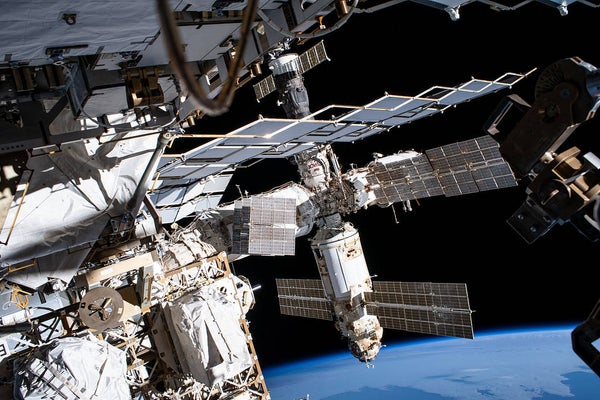
Astronauts on the International Space Station (ISS) briefly took shelter and prepared for a potential evacuation because of worsening air leaks from a Russian-built module, a NASA spokesperson said on June 5.
The leaks are thought to have arisen from microscopic cracks in a transfer tunnel referred to as the PrK, a small vestibule attached to the aft end of the Zvezda Service Module, which leads to a docking port for cargo spacecraft. Zvezda was the first fully Russian contribution to the ISS, and was installed by the country’s space agency Roscosmos in July 2000. Engineers first noticed the leaks in 2019, but despite multiple efforts across the years to seal them and identify their underlying cause, they have remained a chronic problem.
As the leaks have continued, the orbital habitat now loses on the order of a pound of air per day. But at some point during the week of June 1, Roscosmos engineers noticed that the leak rate had suddenly doubled, and also identified some potential new leak areas in PrK, according to a NASA statement released the evening of June 5.
On supporting science journalism
If you're enjoying this article, consider supporting our award-winning journalism by subscribing. By purchasing a subscription you are helping to ensure the future of impactful stories about the discoveries and ideas shaping our world today.
Roscosmos decided today to inspect the area more closely and attempt a repair, which included cutting a bracket in order to allow better access to the suspected leak source. NASA concluded that the procedure involved enough increased risk to direct crew members to take “safe haven” in the SpaceX Dragon capsule as a precaution at 9:03 A.M. EDT. After Roscosmos personnel decided to pause the procedure and not attempt any repair work, NASA ended the safe haven procedure and the astronauts returned to the orbiting laboratory and their regular tasks.
“Following new leaks, Roscosmos has elected to proceed with a more extensive repair operation on Friday, June 5,” said NASA spokesperson Bethany Stevens in a post on the social media platform X. “Out of an abundance of caution, NASA has directed all four of the agency’s SpaceX Crew-12 members and NASA astronaut Chris Williams to assume an elevated safety posture in the [SpaceX] Dragon spacecraft while the repair is underway.”
In a statement released in Russian later in the day, Roscosmos officials wrote, “The situation poses no threat to the crew’s safety or onboard systems; pressure aboard the ISS remains stable and is being maintained at the nominal level,” according to a machine translation.
Astronauts regularly train to respond to a wide range of incidents that might pose a threat to the station and themselves, says George Nield, president of the company Commercial Space Technologies and a former member of NASA’s Aerospace Safety Advisory Panel. “NASA must always be prepared for its astronauts to use their Dragon spacecraft as a ‘lifeboat’ to rapidly return to Earth,” he says. “The increased pressure leak that was announced today is just a reminder that those events can happen at any time.”
Former NASA astronaut Leroy Chiao agrees. “NASA is doing this out of an abundance of caution,” he says, calling the increase in leak rate concerning.
According to NASA statements, the four astronauts of Crew-12 astronauts—NASA’s Jessica Meir and Jack Hathaway, the European Space Agency’s Sophie Adenot and Roscosmos’s Andrey Fedyaev—and NASA astronaut Chris Williams all sought refuge in a docked Crew Dragon spacecraft. Fedyaev’s Russian colleagues Sergei Kud-Sverchkov and Sergey Mikaev remained outside of the Dragon to address the situation.
Shortly after the astronauts entered the Dragon, officials at NASA’s Mission Control Center at the space agency’s Johnson Space Center radioed a directive for them to exit the “safe haven configuration,” noting that “our Russian colleagues have elected to perform measurements only today.”
Stevens clarified her earlier remarks in a follow-up statement on X: “Roscosmos has paused Friday’s structural repair efforts inside the Zvezda service module transfer tunnel, known as the PrK, as more measurements and data is assessed.... We look forward to working with Roscosmos on a collaborative approach to address the leaks.”
Despite the shelter order, the astronauts were probably not in any imminent danger, says Jonathan McDowell, an astrophysicist and space-situational awareness consultant. Onboard air supplies could easily make up the ongoing losses from the leaks. Even so, he says, the situation “is potentially extremely serious.”
“The worry is that a small crack could suddenly get catastrophically bigger,” he says. “That’s unlikely but not impossible, and that would risk loss of the station and crew.”
The scare highlights ongoing concerns over the safety of the aging ISS, which has now been in orbit for more than a quarter-century and is well beyond its intended design life. The leaking PrK has become one of the most significant issues on the station, with NASA officially elevating the problem to its highest category of concern in internal safety evaluations. Protocols are already in place to address the leaks, with the hatch leading from Zvezda to the PrK kept closed unless access to Zvezda is needed. When that hatch is opened, a corresponding hatch capping the U.S. sections of the ISS is closed to limit any catastrophic decompression to Russia’s segment.
NASA has announced plans to retire the ISS by the end of 2030, with deorbiting intended to occur shortly thereafter, but various efforts to further extend the space station’s life are ongoing.
Additional reporting by Meghan Bartels.
Editor’s Note (6/5/26): This is a breaking news story and will be updated.
