
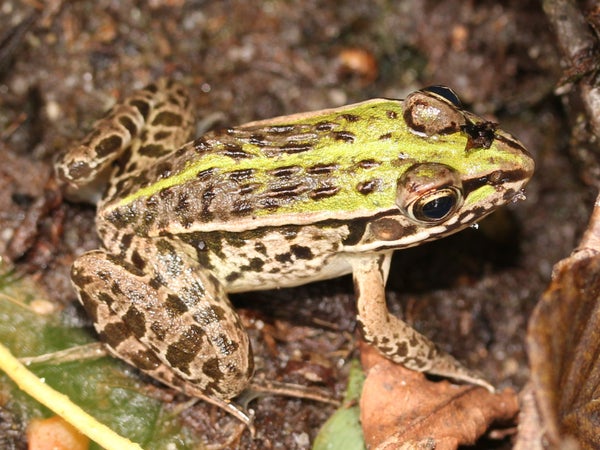

Being swallowed alive by a frog is a death sentence for most insects, but one beetle species shrugs off being digested and instead finds freedom by sneaking out through its captor's anus.
When the pond frog Pelophylax nigromaculatus was presented with the aquatic beetle Regimbartia attenuata, it quickly snapped up the beetle, swallowing it whole and alive. But the meals ended with a strange twist, researchers recently discovered.
In most of the experiments, the beetles reappeared within six hours, slipping out of a frog's anus, or vent. Though muscles typically hold the vent tightly shut, those muscles loosen up when the frog poops; the beetles could be stimulating the frogs' defecation reflex in order to temporarily open this unusual emergency exit, according to the new study.
On supporting science journalism
If you're enjoying this article, consider supporting our award-winning journalism by subscribing. By purchasing a subscription you are helping to ensure the future of impactful stories about the discoveries and ideas shaping our world today.
Shinji Sugiura, an associate professor in the Graduate School of Agricultural Science at Kobe University in Japan, studies anti-predator defenses in wetland insects, and he suspected that the beetle R. attenuata had evolved some type of defense against frogs in their marshy habitat. However, that defense turned out to be very different from what he expected, Sugiura told Live Science in an email.
In September 2019, he provided a juvenile P. nigromaculatus frog with an adult beetle under laboratory conditions. Sugiura guessed that the frog might spit the beetle out, but 105 minutes later, he was astonished to see the live beetle emerging from the opposite end of the frog.
"I used a video camera to record the behavior," he said. "I was very surprised to watch the footage of the beetle escaping from the frog vent."
He conducted the experiment more than a dozen times, and 93% of the swallowed beetles were excreted — always headfirst, Sugiura reported today (Aug. 3) in the journal Current Biology. The beetles were "frequently entangled in fecal pellets," but they "recovered immediately," resuming their beetle business and surviving for at least two weeks following excretion.
Other aquatic beetles in the experiments weren't so lucky. When Sugiura tempted the frogs with the beetle Enochrus japonicus, all of the beetles died inside the frogs and were partly excreted more than 24 hours after being swallowed.
The dark and perilous path from a frog's mouth to its anus travels through the esophagus, stomach, small intestine and large intestine. For a swallowed beetle, passing through this dank and airless internal tunnel from end to end required a minimum of six minutes, though most emerged between one hour and six hours after they were eaten, according to the study.
Frogs typically don't defecate so soon after a meal; this hinted that the beetles were actively provoking the frogs to poop, rather than passively waiting to pass. To test whether the beetles might be using their legs to do this, Sugiura offered the frogs beetles whose legs were fixed together with sticky wax.
None of those beetles survived, Sugiura reported.
"This study is the first to document active prey escape from the vent of a predator and to show that prey may promote predator defecation to hasten escape from inside the predator's body," Sugiura wrote. Further experiments are required to piece together how the beetles encourage the frogs to relax their sphincter muscles; "however, I speculate that R. attenuata use the legs and body to stimulate the frog's hind gut," he told Live Science.
While R. attenuata's escape technique is new to scientists, these insects aren't the only beetles that can evade digestion after they've been eaten. In 2018, Sugiura found that bombardier beetles (Pheropsophus jessoensis), when swallowed by a frog or toad, release a spray of chemicals so toxic that the amphibian inverts its own stomach to vomit out the beetle. The beetle then scuttles away — dripping with mucus and digestive fluids, but otherwise unharmed, Live Science previously reported.
Copyright 2020 LiveScience.com, a Future company. All rights reserved. This material may not be published, broadcast, rewritten or redistributed.