
The reelection of Donald Trump, perhaps more than any other event in modern history, has thrust authoritarianism into the spotlight. From media pundits to conversations held in coffee shops, people are talking about authoritarian leaders. And for good reasons. President Trump and his warning of being a dictator “on day one,” coupled with his attempts to consolidate power, eliminate government oversight and silence his opposition, poses a grave threat to our democratic institutions.
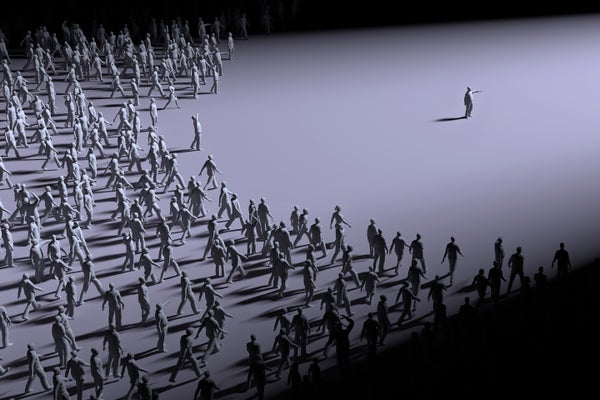
Without downplaying the dangers of authoritarian leaders, studies from my research group and other labs from across the globe identify an equally serious threat to democracy: “authoritarian followers” who instinctively comply with a dictator. We need to understand this personality type so that we can find ways to encourage authoritarian followers to support democracy instead.
For over 80 years, political psychologists like me have studied the authoritarian personality—a collection of attitudes and behaviors that increase a person’s susceptibility to authoritarian leaders. We have found that authoritarian followers share three tendencies: they obey authority figures from their in-group (called authoritarian submission); they punish rule breakers (authoritarian aggression); and they rigidly endorse long-held traditions (conventionalism).
On supporting science journalism
If you're enjoying this article, consider supporting our award-winning journalism by subscribing. By purchasing a subscription you are helping to ensure the future of impactful stories about the discoveries and ideas shaping our world today.
Work from my lab and others reveals that authoritarian followers express a range of anti-democratic attitudes including anti-gay prejudice, anti-immigrant attitudes, generalized prejudice, nationalism and even the belief in conspiracies. Although peer-reviewed work on 2024 Trump voters awaits, authoritarian followers were more likely to vote for Trump than for either Hillary Clinton or Joe Biden in the previous two elections. Thus authoritarian followers are a powerful force within the MAGA movement.
Why do people become authoritarian followers? Some research indicates that authoritarianism is heritable. For example, the correlation between twins’ authoritarianism is over five times stronger among monozygotic twins, whose genetic makeup is almost identical, relative to dizygotic twins, who share roughly half their genes. This strong genetic component to becoming an authoritarian follower does not, however, mean we are destined to obey dictators. Authoritarianism is also fostered by some of the personality traits captured by the so-called Big Five: openness to experience, conscientiousness (a preference for order and the tendency to follow norms), extraversion, agreeableness (the willingness to cooperate and empathize with others) and neuroticism (the tendency to feel anxious and insecure).
Crucially, the social, economic and physical environment also matter. Low levels of openness to experience and high levels of conscientiousness, coupled with an insecure and threatening environment, lead people to chronically view the world as a dangerous and threatening place. When we think that the world is unstable and unsafe, we search for ways to regain control. Unfortunately for our democratic institutions, placing trust in a dictator and becoming an authoritarian follower is one way to reestablish a sense of control.
Far-right politics seem to appeal to authoritarian followers’ desire to regain stability and extinguish perceived threats. For instance, fear and distrust of immigrants has been a core issue driving the recent return of far-right extremism. Movements including Brexit, the rise of the Alternative for Germany (AfD), Marine Le Pen’s successes in France, and Donald Trump’s return to power in 2024 all gained momentum by stoking voters’ fears that our way of life is under threat. Attacks against transgender rights and DEI initiatives are similarly rooted in perceived threats to traditional values.
What can people do to address the recent global surge of authoritarian leaders and followers? As an educator, my first instinct is to argue that we need to increase people’s political knowledge to instill democratic values of tolerance, pluralism and adherence to the rule of law. Yet this approach could backfire. Research on this topic shows that increases in education and political knowledge may make authoritarian followers more, not less, likely to express anti-democratic attitudes. For example, a study in the U.S. found that the relationship between authoritarianism and two core features of conservatism are stronger among those who are knowledgeable about politics.
Alternatively, pro-democracy advocates could employ “jiujitsu” persuasion to target the motivations underlying anti-democratic beliefs. For example, because authoritarianism arises from the need to mitigate perceived threats in the environment, we can expose people to safer ones. Indeed a newly published study by my colleagues and me shows that the diversity of one’s neighborhood correlates negatively with authoritarianism. Multicultural neighborhoods likely provide people with the chance to form close friendships with others from diverse backgrounds. In turn these experiences dispel worries that immigrants threaten deeply held cultural values or will take their jobs.
Other work suggests that we can harness authoritarian followers’ impulse to submit to authority figures and conform to group norms for the social good. For example, research from Singapore—where authorities endorse multiculturalism—shows that authoritarian followers support cultural diversity. Other work from Poland indicates that authoritarian followers support prohibiting hate speech against minority groups including members of the LGBTQ community, Muslims and people of African descent, because this hostile rhetoric violates social norms. These studies show that, under some limited conditions, leaders can harness authoritarian followers’ destructive impulses for the social good.
Although Trump’s return to power has reignited popular interest in authoritarianism, social scientists have long wrestled with its origins. Their insights can help us predict what the next four years will look like, as well as identify ways to address the challenges that are likely to come. Democracy rarely falls at the hands of a single individual. Rather it dies through the complacency and obedience of otherwise well-intentioned authoritarian followers. We must help them follow their better angels. As the historian Timothy Snyder has warned, “Most of the power of authoritarianism is freely given.”
This is an opinion and analysis article, and the views expressed by the author or authors are not necessarily those of Scientific American.
