Why Some Animals Live for Only Days and Others Live for Thousands of Years

Scientists are studying why some species live so much longer than others

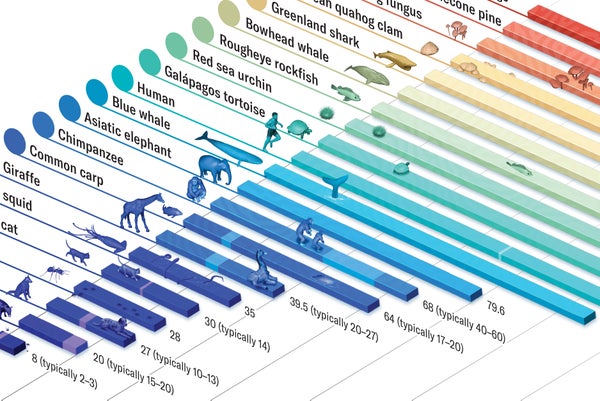
Detail of a bar chart showing the longest recorded lifespan for 24 plants and animals

Mark Belan

Join Our Community of Science Lovers!

Some species seem to live fast and die young. Others, though, “appear not to age,” says João Pedro de Magalhães, a molecular biologist at the University of Birmingham in England. He is project leader of the Human Ageing Genomic Resources program, which keeps the AnAge database of maximum animal lifespans. Some species of turtles, fishes and salamanders, for instance, don’t show any signs of degeneration or senescence as they grow older. If they didn’t die of predation, accidents or infectious disease, they could live extremely long lives, Magalhães says.

“It’s a biological mystery why some species age faster than others,” Magalhães says. “We still don’t understand well the mechanisms behind aging.” Species that face high predation usually evolve to grow quickly and reach sexual maturity rapidly. Other creatures that don’t face pressure to reproduce early can age slowly: Greenland sharks, for instance (the top of their food chain), may take 150 years to reach sexual maturity.

DNA mutations are thought to play a role in determining lifespans, with longer-lived species tending to evolve better DNA-repair systems to help ward off cancer. Short-lived creatures, such as mice, don’t have these abilities, because in the wild they often die of predation before cancer becomes an issue. Laboratory-raised mice, however, have very high rates of cancer.


On supporting science journalism

If you're enjoying this article, consider supporting our award-winning journalism by subscribing. By purchasing a subscription you are helping to ensure the future of impactful stories about the discoveries and ideas shaping our world today.
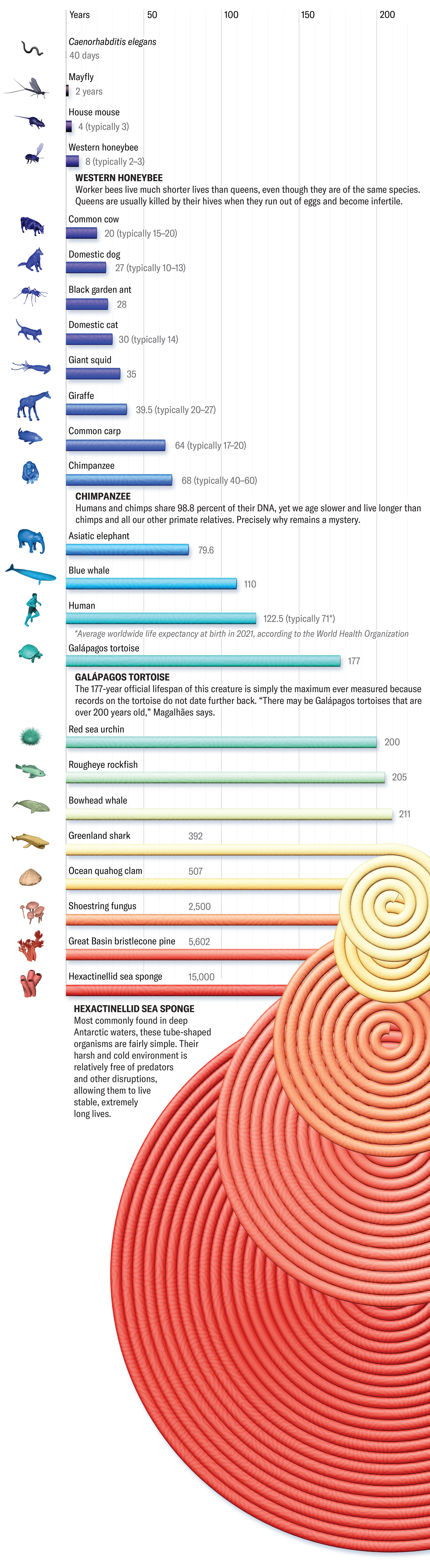

Longest recorded lifespan for 24 plants and animals are shown, from C. elegans (at 40 days) to the Hexactinellid sea sponge (at an estimated 15,000 years)

Mark Belan; Source: AnAge: The Animal Ageing and Longevity Database/Human Aging Genomic Resources (longevity data); Animal Diversity Web (most of the typical lifespan values)

Clara Moskowitz is chief of reporters at Scientific American, where she covers astronomy, space, physics and mathematics. She has been at Scientific American for more than a decade; previously she worked at Space.com. Moskowitz has reported live from rocket launches, space shuttle liftoffs and landings, suborbital spaceflight training, mountaintop observatories, and more. She has a bachelor’s degree in astronomy and physics from Wesleyan University and a graduate degree in science communication from the University of California, Santa Cruz.

More by Clara Moskowitz

Mark Belan is a scientific illustrator and visual communicator. His work translates scientific ideas and data into didactic visuals. His work can be found at www.artscistudios.com

More by Mark Belan
Scientific American Magazine Vol 332 Issue 5This article was published with the title “Lifespan Limits” in Scientific American Magazine Vol. 332 No. 5 (), p. 94
doi:10.1038/scientificamerican052025-7KQTl66lsO56DwxwJTDKE

It’s Time to Stand Up for Science

If you enjoyed this article, I’d like to ask for your support. Scientific American has served as an advocate for science and industry for 180 years, and right now may be the most critical moment in that two-century history.

I’ve been a Scientific American subscriber since I was 12 years old, and it helped shape the way I look at the world. SciAm always educates and delights me, and inspires a sense of awe for our vast, beautiful universe. I hope it does that for you, too.

If you subscribe to Scientific American, you help ensure that our coverage is centered on meaningful research and discovery; that we have the resources to report on the decisions that threaten labs across the U.S.; and that we support both budding and working scientists at a time when the value of science itself too often goes unrecognized.

In return, you get essential news, captivating podcasts, brilliant infographics, can't-miss newsletters, must-watch videos, challenging games, and the science world's best writing and reporting. You can even gift someone a subscription.

There has never been a more important time for us to stand up and show why science matters. I hope you’ll support us in that mission.

Thank you,

David M. Ewalt, Editor in Chief, Scientific American

Subscribe