
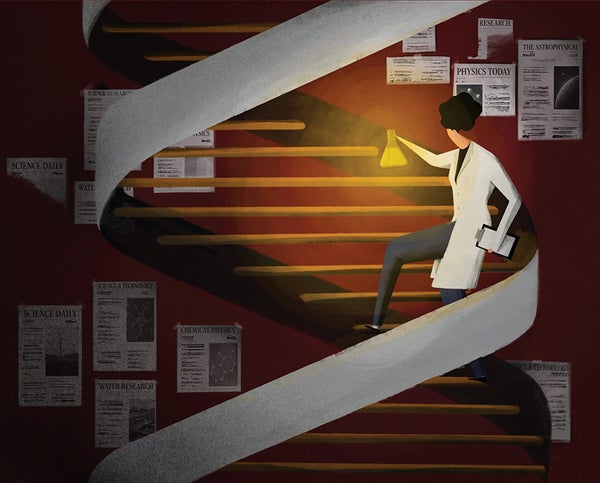
When Emma Scales decided she wanted to be a scientist, it seemed logical—simple, even. She’d grown up in coastal New Jersey, attended a high school that emphasized marine biology, and learned about the connections among sea creatures large and small. She felt a calling to better understand and protect a world she loved.
Now a Ph.D. candidate at Cornell University, Scales is studying symbiosis, specifically the way bacteria can grow inside fungi and create a mutual-use arrangement. It’s what she calls a “Russian nesting doll” system. But these days little seems simple or logical. Scales’s research is aimed largely at protecting food crops, and at Cornell she’s recently watched laboratories shut down because of federal funding cuts, including labs running practical programs meant to help strengthen U.S. agriculture. Since 2025 the Trump administration has cut more than 7,800 grants, removed 25,000 scientists and related personnel from their jobs, and, as of January 2026, proposed budget cuts equaling about $32 billion. Cornell has recovered its funding, but doing so came with its own heavy costs, and warning signs are still flashing.
Scales is one of thousands of early-career researchers in the U.S. trying to make sense of how the current tumult in American science will shape their professional paths. Between lost funding and stalled programs, the young scientists of today are facing uncertainty in the job market and the possibility of having to leave the U.S. or, in some cases, leave science completely.
On supporting science journalism
If you're enjoying this article, consider supporting our award-winning journalism by subscribing. By purchasing a subscription you are helping to ensure the future of impactful stories about the discoveries and ideas shaping our world today.
But Scales has decided to fight back, joining with other graduate students trying to protect universities. “They are scrubbing science of the influence of some of its most brilliant scientists. Work that has taken decades to build is being wiped out,” she says. When the research community gets a chance to rebuild, she wonders, how long will it take to regain what’s been lost?
Julia Menzel, an American early-career science historian currently at the University of Toronto, has similar questions. “There has got to be some way to dull the negative impact this has on people trying to start their careers in science,” she insists. “If we lose a generation of scientists, we are going to see very negative consequences.”
Menzel’s research, which she began while completing a Ph.D. in the history of science at the Massachusetts Institute of Technology, tells us that the country has faced these kinds of challenges before. Administrations hostile to evidence have previously worked to dismantle the U.S. scientific enterprise. And history is cyclical—many science historians point to similarities between the eras of Donald Trump and Richard Nixon and the ways these presidents sowed distrust of science among Americans to push their agendas. For example, in an echo of today, Nixon imposed widespread cuts to research funding while redirecting money to his chosen science projects. In subsequent administrations, science regained both money and status, in part because of strategic advocacy by scientists. Will such a pattern repeat this time around?
David Kaiser, a physicist and historian of science at M.I.T. who mentored Menzel, believes that the past tells us to hold on, that we don’t yet know the end of the story. But the solution may come from young scientists like Scales who take on the task of rebuilding science as a profession. They may need to use a new blueprint. They may need to invent their future. But first they need to survive the present. “There’s now a deeply felt uncertainty about science,” Kaiser says with a sharp edge of worry. “There are so many students, so gifted and earnest, who go into research because they want to help the world. And they are marching toward a future that looks nothing like what I had hoped for them.”
The U.S. has long been committed to supporting R&D. In 2023 the country’s investment in research was about 3.45 percent of its gross domestic product, making it the fifth-highest worldwide. The National Science Foundation says the total amount spent on science in 2024 was $993 billion. Of that, almost 19 percent came from the federal government. Nearly 76 percent came from industry. In 2024 federal research dollars went mostly to federal agencies and certain public-private research partnerships (43 percent), then universities (31 percent) and businesses (19 percent).
The return on investment for science is equally enormous. The National Institutes of Health alone provide more than $69 billion toward the U.S. GDP through research, and a medical-research advocacy group reports that every NIH dollar spent on research returns $2.57 in new economic activity. The Federal Reserve Bank of Dallas has found returns of up to 300 percent from government research and development since the days after World War II.
Science itself is not partisan, and research is supposed to inform policymaking. Yet science funding in the U.S. has long been a political pinball.
President Barack Obama promised that “the days of science taking a back seat to ideology” were over in 2009, saying he hoped to double federal research spending during a time when federal spending was in a minor upswing. But a Congress dominated by the Tea Party thwarted him. In the end, according to an analysis by the American Association for the Advancement of Science, congressionally approved funding by federal agencies instead dropped a full 10 percent, when adjusted for inflation.
The first Trump administration immediately sought to deepen those cuts. This move, too, was stymied by congressional resistance. The budget of the NIH—the largest supporter of research at U.S. universities—went from about $30 billion in 2015 to more than $48 billion in 2025, in part because of President Joe Biden’s call for greater investment in research. Biden, in fact, campaigned on a promise to respect scientific advice; Trump responded by mocking Biden for listening to scientists.
The second Trump administration has further targeted science funding. It has frozen grants and other money across the spectrum of research. The proposed budget for fiscal year 2027 asks to reduce the amount earmarked for nearly every federal science agency, including a 55 percent cut to the NSF. And although Congress has voted to restore much of the funding and federal judges have tried to intervene, the administration has used internal agency decisions and presidential memos to slash budgets as often as possible—and, on occasion, simply held back money authorized by Congress. “I don’t think anyone was prepared for the aggressiveness and suddenness of the cuts,” says University of Maryland, College Park, historian of science Melinda Baldwin. “I can’t really think of a similar moment in the past where funding has been cut off that fast.”
But government hasn’t always been the primary funder of science. In the 19th century, research was largely practical, seen as the purview of independent businesspeople. Take Eli Whitney’s invention of the cotton gin, which revolutionized the mechanical aspects of farming in the early 1800s, or Alexander Graham Bell’s commercial development of the telephone later that century. Both men had benefactors supporting their efforts.

Pepe Serra
The benefactor model of funding and investing in innovation continued well into the 20th century. In the 1940s, when federal funding of basic research arose, the U.S. populace, battered by the Great Depression, was already becoming critical of scientific research. Like Americans today, Kaiser says, society then “feared technology replacing jobs and technocracy putting science before people.”
But those fears were drowned out by the drumbeat of war. The U.S. military thought that winning World War II would depend on also winning the scientific-innovation race. The country needed new lifesaving techniques for wounded soldiers, more durable tanks and aircraft, and more lethal weapons, which eventually led to nuclear bombs. The global war rewrote the funding conversation, and the cold war that followed continued it. After the Soviet Union’s 1957 launch of Sputnik, the world’s first artificial satellite, the U.S. government leaped into a space race, and its commitment to American science took off like a rocket itself.
In 1950 President Harry Truman created the NSF to make smart decisions about what research to fund. By 1957 the NSF budget was about $40 million. A little more than a decade later, in 1968, it was $500 million. Federal spending on R&D rose steeply between 1940 and 1968, when it reached more than $24 billion. Experts calculate that at that point the national government was paying for more than 60 percent of all basic R&D in the U.S.
“I actually think of the 1950s and 1960s as an aberrant time in economics,” says Katherine Pandora, a historian of science at the University of Oklahoma. “A lot of people today say that should be the norm. But it was not normal; there was an unnatural amount of money going into universities.” She adds, “Even the humanities were in clover.” The coffers of science were overflowing. Realistically, it couldn’t last.
And it didn’t.
By the late 1960s the funding conversation was once again being rewritten, this time by the Vietnam War. Among Americans, Vietnam was an unpopular conflict, one that would eventually kill almost 60,000 U.S. soldiers, by many accounts more than a million Vietnamese soldiers, and between one million and two million civilians. Protests ignited around the U.S., and for many young Americans the villains of the story included the scientists and universities helping to make the weapons of war, including possibly improved nuclear weapons. A history of the NSF notes that by 1969 “the mood of the country had become mistrustful of science in general”—and violent. In one notorious incident, antiwar activists set off a bomb on the University of Wisconsin–Madison campus in 1970. The target was the Army Mathematics Research Center. The middle-of-the-night explosion killed a researcher, injured at least four people and damaged not only the center but more than two dozen other buildings.
This set the stage for Nixon, elected in 1968, to take on academic science as the enemy.
Although Nixon did not overtly campaign on the issue, like Trump, he moved quickly to put research in its place. “I see a lot of Nixon in the way that [Trump] and his surrogates use language to justify what they’re trying to do to federal research,” says Baldwin, a co-author of an American History Association review of the history of U.S. science funding. For instance, both men have demonstrated a belief that “scientific research should be held accountable to the executive branch.”
There’s a strong consensus among historians, including Baldwin, that Nixon’s concept of an imperial presidency bringing scientists to heel foreshadowed Trump’s approach and that of his administration. “There are many eerie similarities to today,” Kaiser agrees.
But the government tide was already shifting when Nixon took office. In the mid-1960s government officials became concerned that research spending was running unchecked. In 1966 the Department of Defense started wondering whether it was getting its money’s worth. The number of physics Ph.D.s in the country had roughly doubled since Sputnik, but they weren’t churning out the same supercharged innovations and weaponry as before. “The military liked having scientists on tap but started to think they weren’t on top of what mattered,” Pandora says. “They’d supported lots of basic research that hadn’t generated useful results. They wanted more practical value for their dollar.”
Federal support of U.S. research declined accordingly. NASA began winding down its Apollo rocketry program after the successful moon landings of 1969. In 1971, Kaiser says, about 1,000 people graduated from American universities with new physics Ph.D.s and had to compete for fewer than 100 jobs. By 1975—partly at the direction of the Nixon administration—federal funding for non-defense-related research had dropped by more than 20 percent since the high-water amounts of the 1960s. At one point Nixon tried to impound congressionally approved funds for sewage cleanup despite having started the U.S. Environmental Protection Agency in 1970 to bring the environmental activities of multiple agencies under one roof.
“We’re now at risk of dismantling the essential infrastructure of medical research.” —Harmit Malik, Fred Hutchinson Cancer Center
The Vietnam War, and the bitter reaction to it at home, shifted something else. American conservatives began to suspect that while learning the skills to become scientists and engineers, students were also learning a liberal worldview that might challenge traditional American values. Politicians found it easy to blame university professors for fostering not only left-leaning attitudes but a sense of superiority to go along with them.
“The Nixon crowd was very good at playing on tropes of scientists being elite and aloof and disconnected from real Americans,” says Menzel, who has researched how challenges to the authority of scientists in the late 1960s started changing the politics around science. Nixon both leaned publicly into antiscience rhetoric and fostered it internally, placing antiscience skeptics in positions of power in the administration.
In early 1973 Time magazine reported that Nixon had “all but exiled Washington’s science establishment.” He abolished the post of Presidential Science Adviser, the Office of Science and Technology and the President’s Science Advisory Committee. He announced cross-agency budget cuts that would drastically reduce funding for training young scientists. Nixon also decided to redirect NIH funding to a “war on cancer,” leading the assistant secretary for health to resign in protest. Like Trump, Baldwin says, “Nixon had a lot of appointees perceived as extremely hostile to NIH.”
There are other parallels to today. The Vietnam War had proved more costly than projected, absorbing a large part of the federal budget. Oil prices had spiked, and inflation was increasing. Nixon’s treasury secretary, George Shultz, the first head of the Office of Management and Budget (OMB) and later secretary of the treasury, followed Nixon’s lead on cutting spending and saw basic science dollars as an obvious target. The same might be said about the current head of the OMB, Russell Vought, who has not only directed historic cuts to federal science agencies but also frozen research funds even when they had been approved for use by Congress.
But Vought has gone further than Schultz. Although Congress gave bipartisan approval to restore much of the NIH budget in early 2026, Vought was slow to release the money; none reached the agency before mid-March. As a result, the agency’s work has faltered, and many programs remain in a state of paralysis. As Harmit Malik, an evolutionary biologist and associate director of basic sciences at the Fred Hutchinson Cancer Center in Seattle, puts it, “we’re now at risk of dismantling the essential infrastructure of medical research.”
But the Nixon presidency also stirred scientists into protective action. Over the next decade researchers responded strategically, adopting carefully tailored messages to encourage federal investment in their work.
Take physicist Kenneth Wilson, for example. Menzel has studied the lobbying tactics of the 1982 Nobel laureate. Dismayed by the extent of federal funding losses, in 1981 Wilson warned of the eventual “liquidation of the American basic research establishment.” Menzel says he and his colleagues emphasized pragmatism, pointing out that research was one of the great engines of the U.S. economy.
The election of less hostile leaders helped. Both President Jimmy Carter and President Ronald Reagan—whose administration Wilson lobbied directly—increased the federal government’s commitment to basic research. Since then, the government’s commitment has remained relatively consistent, although, as Pandora notes, it never returned to what many perceived as the flush spending of the mid-20th century. Still, in fiscal year 2024, the U.S. government funded more than half of academic research in the country, and universities are now in a markedly vulnerable position as such support is withdrawn.
Even industry isn’t safe from Trump officials sowing the seeds of mistrust in science. For example, consider the public stance U.S. health secretary Robert F. Kennedy, Jr., has taken on the pharmaceutical industry. There’s an implication, says Michael Xenos of the University of Wisconsin–Madison, in the administration’s messaging today that “scientists want to manipulate you and at the same time enrich themselves.” Xenos’s research focuses on the politics of science communication. He notes, not surprisingly, that the Trump administration’s message plays best with those already inclined to doubt that scientists operate on altruistic principles.
American faith in institutions in general has been eroding for decades. In 1964, 77 percent of U.S. citizens surveyed said they trusted the federal government to do the right thing. Since 2008 that number has remained consistently below 30 percent, according to the Pew Research Center. Yet despite all the negative messaging, trust in scientists has remained strong. In 2024, 76 percent of respondents in a Pew survey expressed at least “a fair amount of confidence” that the country’s scientists act in the nation’s best interests.
But trust in government runs along party lines, a trend that Xenos attributes partly to the GOP’s messaging to non-college-educated voters. “These are often people who feel left behind by the system, and they don’t really appreciate experts telling them what to do,” he says.
The Trump administration took advantage of the way the COVID-19 pandemic added to existing resentments. Scientific advice aimed at saving lives led to closed schools and lost jobs. Critics deftly attributed those outcomes to scientific indifference to the struggles of the American public, suggesting the blame for people’s hardships could be placed on the country’s so-called experts.
The percentage of Americans who said they trusted doctors fell from around 70 in spring 2020 to 40 in spring 2025. Meanwhile Trump selected Kennedy, an attorney and vaccine critic, to run the Department of Health and Human Services. Kennedy has moved to radically reshape the department, cutting a swath of public health programs. And other agencies, such as the U.S. Forest Service, also have begun dismantling research programs.
It took a good decade to restabilize American research after the Nixon presidency. Today no one is sure when things will feel stable again. Malik warns that research is unlikely to be rebuilt quickly: “It’s not going to just come back when we turn the taps on again.”
Germany exemplifies this scenario, historians say. The country was once considered the world’s leader in scientific research. After World War II it took decades for it to reclaim its international research standing. “I think something that the history of science can give us,” Kaiser says, “is a little bit of, not always hope, but patience.”
If federal funding of science is to recover, it may be helped by lessons from the past in the vein of Wilson and his way of countering antiscience sentiment. And both history and the present are now prodding scientists, especially younger ones, to share the importance of their work with policymakers and the public.
These ideas led Scales and a network of equally dismayed graduate students to organize a share-the-science information campaign last year. They named the project the McClintock Letters, after Nobel Prize–winning American plant geneticist Barbara McClintock. Starting in summer 2025, hundreds of graduate students have written to their hometown newspapers about their work and why it shouldn’t be lost.
One of the McClintock Letters collaborators, Miles Arnett, a Ph.D. student studying cell regeneration in the human gut at the University of Pennsylvania, wrote about the way he had learned to love science as a child growing up in Worcester, Mass. And he wrote about his fears that the city—home to a host of research institutions, including a medical school—could be deeply impacted by the federal budget cuts.
Too many scientists, Arnett believes, live in a world somehow separate from the rest of society. The McClintock Letters project is an effort to change that, but “if we’re going to earn the trust of the American public back, it can’t be the idea that science exists over here, and everything else is over there. We’re going to have to reach out directly. We’re going to have to be seen.”
Xenos hopes that his own area of study into the knotty questions of trust and engagement will help a new generation of scientists better relate to the public. “We need to recognize that people can use mistrust of science for their own selfish agendas and to acknowledge that some Americans feel burned by the system.”
Arnett and his friends worry about the future of science in the U.S.—“it would be silly not to”—and the many consequences of federal actions. He and Scales cite the dramatic loss of international students and their perspective, as well as the way the Trump administration’s stance on diversity initiatives could result in students of color being excluded no matter how brilliant they are. Arnett notes that he has friends who are considering going abroad. Recently, Malik has encouraged his students to consider several options for their training, including institutions in other countries, although he knows many would rather stay in the U.S. “My students still believe in this country,” Malik says. “And they feed me hope.”
To that end, Scales wishes passionately that universities would fight harder; Arnett worries about friends and colleagues discouraged by the federal government’s lack of support for their work. But maybe, Scales says, all the harm will force the research community to not just express dismay but do something about it. “Maybe it could be seen as an opportunity,” she says. “And I can’t help cringing when I say that.”
Arnett agrees. “Maybe this is a chance to rebuild research institutions that are more engaged with the public. Maybe it’s a chance for institutions to start including and rewarding good communication as part of scientific training,” he says.
But neither of them would choose to remodel under these circumstances. Scales says ruefully, “It’s like the opportunity you have to build a better house when yours burns down.”