
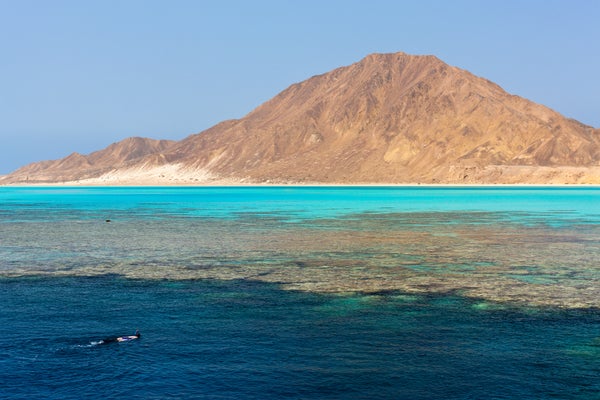
All around the world, from the Red Sea to the deep ocean ridges of the Atlantic, lurk more than a dozen geological misfits. These scraps of continental crust are found in the middle of oceans, sometimes hundreds of miles from the nearest continent. Scientists have been mystified for decades by how they came to be there; the fragments “were even used as an argument against plate tectonics,” says João Duarte, a geologist at the University of Lisbon in Portugal.
But a recent study in Nature Geoscience suggests that these misplaced fragments fit just fine within our understanding of plate tectonics and actually trace back to the chaotic first moments of the breakup of ancient supercontinents. As a continent begins to unzip—as is happening now at the Red Sea—narrow fault zones can isolate small chunks of continental crust, marooning them on a raft of newly formed oceanic crust.
When continents break apart, they form new plate boundaries at what are called mid-ocean spreading centers: magma-gurgling conveyor belts that create new oceanic crust and drive continents apart. The black expanse of thin, dense and relatively young basalt from those centers stands in stark contrast to thicker, more buoyant continental crust, which is primarily granite but contains the full gamut of sedimentary, metamorphic, and igneous rocks and can be billions of years old. So when scientists discovered slivers of much older continental crust surrounded by younger oceanic material, something didn’t add up.
On supporting science journalism
If you're enjoying this article, consider supporting our award-winning journalism by subscribing. By purchasing a subscription you are helping to ensure the future of impactful stories about the discoveries and ideas shaping our world today.
When looking at the out-of-place pieces of continental crust, researchers eventually noticed a pattern: continental scraps turned up at transform faults, where mid-ocean ridges kink at right angles and crustal blocks slide past one another perpendicular to the ridges. To sort out what was happening, Attila Balázs, a geophysicist at the Swiss Federal Institute of Technology Zurich, and his colleagues used high-resolution, three-dimensional computer models to put the continents back together again.
When several landmasses collided to form the supercontinent Pangea long before the dinosaurs, Earth’s crust shattered into discrete blocks and folded like a rug pushed against a wall, rising to form mountains spanning from the Appalachians to the Atlas. “It’s a bit like breaking a plate or dropping a glass. There will be many fractured and weak zones,” Balázs says. When the tectonic plates began to pull apart millions of years later, those ancient faults at their edges reawakened, reincarnated as transform faults.
The continental castaways that had stumped geologists formed under specific conditions as the continents pulled apart: the first requirement was that continents split slowly at an oblique angle to each other. As the continents sheared and twisted unevenly, local forces squeezed together thin ribbons of crust and popped them up like geological meerkats, isolating and slicing them off. Finally some magma emerged during the process but not so much that it melted the slivers away. With these rare conditions satisfied, chunks of continental crust rode along these rejuvenated faults and drifted into new ocean basins. The process, Balázs says, takes up to 30 million years to unfold.
Susanne Buiter, a geophysicist at GFZ Helmholtz Center for Geosciences in Germany, who was not involved in the study, says the new three-dimensional model helps to reconcile a long-standing mystery. Classic plate tectonic theory assumed that continents broke apart cleanly, but “maybe the breakup is not always so clean,” she says.