
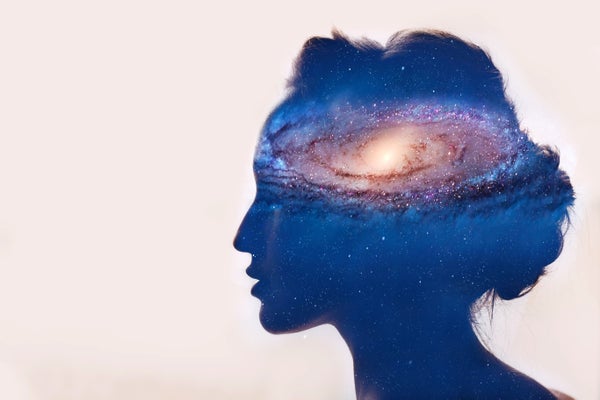
One of science’s most challenging problems is a question that can be stated easily: Where does consciousness come from? In his most recent book, Galileo’s Error: Foundations for a New Science of Consciousness, philosopher Philip Goff considers a radical perspective: What if consciousness is not something special that the brain does but instead is a quality inherent to all matter? It is a theory known as panpsychism. He answered questions from former longtime Mind Matters editor Gareth Cook.
Can you explain, in simple terms, what you mean by panpsychism?
In our standard view of things, consciousness exists only in the brains of highly evolved organisms, and hence it exists only in a tiny part of the universe and only in very recent history. According to panpsychism, consciousness pervades the universe and is a fundamental feature of it. This doesn’t mean that literally everything is conscious. The basic commitment is that the fundamental constituents of reality—perhaps electrons and quarks—have incredibly simple forms of experience, and the very complex experience of the human or animal brain is somehow derived from the experience of the brain’s most basic parts.
On supporting science journalism
If you're enjoying this article, consider supporting our award-winning journalism by subscribing. By purchasing a subscription you are helping to ensure the future of impactful stories about the discoveries and ideas shaping our world today.
I should clarify that by “consciousness,” I don’t mean self-awareness or the capacity to reflect on one’s own existence. I simply mean “experience”: pleasure, pain, visual or auditory experience.
Human beings have a very rich and complex experience; horses less so, mice less so again. As we move to simpler forms of life, we find simpler forms of experience. Perhaps at some point the light switches off, and consciousness disappears. But it’s at least coherent to suppose that this continuum of consciousness carries on into inorganic matter, with fundamental particles having unimaginably simple forms of experience.
What does panpsychism seek to bring to physics?
Philosophers of science have realized that physical science, for all its richness, is confined to telling us about the behavior of matter, what it does. Physics tells us, for example, that matter has mass and charge. These properties are completely defined in terms of behavior—things like attraction, repulsion, resistance to acceleration. Physics tells us absolutely nothing about what philosophers like to call the intrinsic nature of matter: what matter is in and of itself.
Consciousness, for the panpsychist, is the intrinsic nature of matter. There’s nothing supernatural or spiritual, but matter can be described from two perspectives. Physical science describes matter from the outside in terms of its behavior. But matter from the “inside”—that is, in terms of its intrinsic nature—is constituted of forms of consciousness.
Do you foresee a scenario in which panpsychism can be tested?
You can’t look inside an electron to see whether or not it is conscious, just as you can’t look inside someone’s head and see their feelings and experiences. We know that consciousness exists only because we are conscious.
Neuroscientists correlate certain kinds of brain activity with certain kinds of experience. We now know which kinds of brain activity are associated with feelings of hunger, pleasure, pain, and so on. This is really important information, but what we ultimately want from a science of consciousness is an explanation of those correlations. Why is a particular feeling correlated with a particular pattern of brain activity? As soon as you start to answer this question, you move beyond what can be, strictly speaking, tested, simply because consciousness is unobservable. We have to turn to philosophy.
Science gives us correlations between brain activity and experience. We then have to find the philosophical theory that best explains those correlations. In my view, the only theory that holds up to scrutiny is panpsychism.