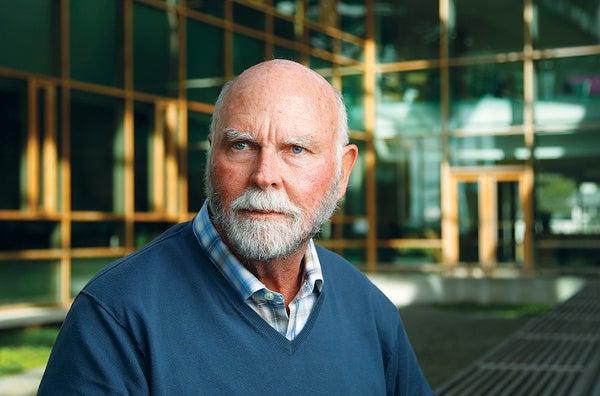
J. Craig Venter was a pioneer in the fields of human genomics and synthetic biology, pursuits that both put him in the spotlight and earned him the label of “controversial.”
Venter’s scientific achievements and character were fodder for a flood of obituaries and social media posts that poured in after the announcement of his death at the end of April, at the age of 79. “Craig was a divisive figure but had huge chutzpah and was always driven on by the science,” says Roger Highfield, a science journalist who knew Venter professionally, having both edited two of the geneticist’s books and written about him over the years. (Highfield is also science director of the U.K. Science Museum Group.)
When I spoke with Venter over video about the state of American science, just a month prior to his death, his bearing—described as “swashbuckling” by Highfield—seemed softened by humility and thoughtfulness. At one point, he veered into more philosophical territory and remarked on the absurdity of the goal of living forever. “If you want immortality,” he said, “do something meaningful while you’re alive.”
On supporting science journalism
If you're enjoying this article, consider supporting our award-winning journalism by subscribing. By purchasing a subscription you are helping to ensure the future of impactful stories about the discoveries and ideas shaping our world today.
J. Craig Venter sat down with SciAm weeks before his passing, and spoke widely about genomics, AI hype, what the Trump administration has gotten right about science, and his view of a path to immortality.
Venter’s own goals were shaped by early experiences outside of academia. “I started my science career by getting drafted and spending a year in Vietnam as a medic and learning that fundamentally the biggest thing I had to lose was my life.”
Venter went on to lead a number of trailblazing efforts that transformed human understanding of biology. In 1995 he published the first bacterial genome sequence. Five years later, using a whole-genome shotgun-sequencing method that he developed, Venter and the government-backed Human Genome Project announced the first fully sequenced human genome. He then turned his attention to synthetic genomes, creating the first synthetic, self-replicating bacterial cell in 2010.
An edited transcript of the interview follows.
How would you describe the current state of American science?
I’d say the best way to describe it is that it’s in extreme flux for all kinds of reasons, not just political. Artificial intelligence has entered the scene in an interesting way. It may be a little bit overhyped, but it’s certainly affecting how people think about the future of science. I think people are looking for miracle solutions with AI that aren’t going to occur. When we made the first synthetic cell, about a quarter of the genes were of completely unknown function. AI is worthless as a tool to identify the function of those genes because if it’s not part of the training set, it doesn’t exist in its world. All these people who are talking about how AI is going to design new genomes, design whole new things—it can’t make things outside of its repertoire.
We’re all limited by our training sets, but humans have the unique ability of being able to assemble things from missing pieces. That’s what I’ve been particularly good at—taking complex concepts and seeing what’s next, figuring out what we have to solve and answer to get there.
We’re also in flux because of the funding and the competition and the political turmoil in the world. So much of science now is dependent on open, candid communication across countries and open movement of people. We’re suffering a lot in the U.S. medically because so many of our interns and residents have traditionally come from overseas, but in many hospitals now there are huge wait times because we’ve blocked the workforce from coming in. The same is true for science with postdocs and graduate students.
This is the fuel that feeds the future of science—new young blood coming in and getting educated and excited about the future. We’re shooting ourselves in the foot a little bit there, and at the same time we’re facing increasing competition at very substantial levels. For example, in the field of synthetic biology, China’s outspending the U.S. 10 or 15 to one.
What do you think needs to change in American science?
There are so many things that need to change. I think we’re slowly getting back there. The good news over the years is—and most people aren’t aware of this—Republican Congresses have generally been more supportive of disease research and funding at the National Institutes of Health than Democratic governments. Congress is starting to get a little bit of a backbone and put some funding back into getting good, solid, basic science going. We still need to make a whole lot of changes in science.
In addition to funding basic science, what other changes would you like to see?
I’ll answer with an example from 1995, when Hamilton Smith, the Nobel laureate, and I wrote a grant and submitted it to the NIH, proposing our idea for shotgun sequencing to sequence the first genome in history. It was turned down with extreme prejudice—even though we were almost finished with the genome and had no doubt in our minds it was going to work, the mathematics would work, the assembly worked. I wrote a letter to Francis Collins [who was at the time the director of the National Human Genome Research Institute at the NIH] saying, “You should consider funding this just so the NIH won’t be embarrassed when, after you turn it down, we go ahead and are first in history.” I still have the letter that I got back, saying that they totally stand by their decision, and they’re certain that it won’t work. A short time later we published the first sequence of the full genome.

J. Craig Venter poses with his dog, Darwin, in 2011.
Eli Meir Kaplan/The Washington Post/Getty Images
Are you saying government agencies should financially support these types of endeavors?
In a sense. Because we proved an idea worked, we then were flooded with funding from the NIH, the Department of Energy, and other agencies to do more genomes. They’ll fund an idea after it’s proven to be correct, but that’s not how science works at its best. We should fund new ideas and take risks to get to those new ideas faster. The American people should feel outraged that they’re not getting 10 times the discoveries that they are getting, because we don’t fund new ideas. Several years ago, when Elias A. Zerhouni was the NIH director, he wanted to form a special award for high-risk research, and he asked molecular biologist and Nobel laureate Sydney Brenner and me to head up a committee to recommend candidates for this award. We came up with 10 top candidates. The NIH decided they were all too risky and didn’t want to give them the award for high-risk research, because it sent the wrong message.
What’s missing are more opportunities for young scientists to come in and be able to take these risks, try things, and get rewarded or learn from the failure. I know a lot because I failed so many times that I’ve learned more from the failures than from the successes.
Speaking of young scientists, what piece of advice would you give to early-career scientists right now?
You have to take risks. If you’re risk averse, you’re in the wrong field. It’s the definition of doing an experiment. You don’t know the outcome. My favorite job is being an experimentalist. I can ask questions and try to get answers. Being a fundamental experimentalist is the essence of science. I’ve been very lucky in my career in having the ability to try to answer big questions. Most people are afraid of trying to do that.
You mentioned your time as a medic in the Vietnam War as shaping your scientific path. Is that where your love of risk-taking comes from?
I was always a risk-taker, but that experience in the war sort of set the philosophy for the rest of my life. I wanted to apply my skill set to honoring the thousands of young men and women my age fighting in a war that almost nobody believed in. I went back to school to get an education and try to honor these people by doing something meaningful with my life.
What gives you optimism right now in science and innovation here in the U.S.?
Things seem bleak, but currently we’re still hanging on, maybe by a tooth, to leading the world in science. This is in large part because of philanthropy. We have unique institutions and unique ways of thinking in the U.S. that almost do not exist anywhere else in the world. A lot of people are doing amazing things with the fortunes they’ve inherited or developed, and that’s the backbone of how we move science forward. People think it’s government funding. Government funding sort of fills in the backbone, builds our infrastructure—without [funding for] indirect costs, I can’t pay for my building, my electricity, the human resources people, anything. The infrastructure of science is just as critical as the funding for new ideas, but we have a great combination of government and philanthropic funding because people do believe in putting money in science.
People are also excited about new computing tools. It’s hard to imagine how powerful computers will become. It’s been more than 25 years since we sequenced the first human genome, and we now have whole new tools to start it over again the right way.
What do you mean by doing sequencing “the right way”?
We all had these great dreams 25 years ago, and they got sort of subverted by geneticists being sure that changes in a single nucleotide base, or letter, of DNA explained everything in the genetic code. Which they don’t.
It’s taken 25 years to realize how faulty that notion is. The NIH chose just to fund the sequencing of more genomes instead of trying to understand your complete set of observable traits. Sequencing more genomes tells us a lot about ancestry and history. It doesn’t tell you the shape of your face, the spectrum your brain will function at, or your genetic susceptibility to environmental interactions, disease or wellness.
This is where AI can be helpful—taking all the information we could know about an individual and relating it back to their genome. We’ll be able to do this tens, hundreds of thousands, millions of times faster as the tools get better. The tools still have to be developed, but that’s why I’m optimistic. What we dreamed about 25 years ago is now doable.
How have AI and new technology changed the field of genomics in the past few years?
Just in the past few months, even. It’s the mathematical tools. It’s the AI. It’s just the fundamental change in computing. In 1999 I built the third-largest civilian computer in the world. It was one and a half teraflops. It filled two giant rooms. Now you can have a laptop that’s much more powerful than that. Computing technology, memory, large language models, and other new tools we now have can find associations between things that the human eye can’t readily discern.
In genomics, we used to get just a collection of fragments. Now we can have complete genomes. We can understand your mother’s genome, your father’s genome. It’s called the diploid genome. In January we started a company called Diploid Genomics, Inc., to deploy genomics to really start to understand humanity at its most basic level. We’re calling it genome 2.0. I never thought it would take 25 years to get here, but some things move more slowly than others.